

Lead-Free Solder: What You Need if You Are Selling It
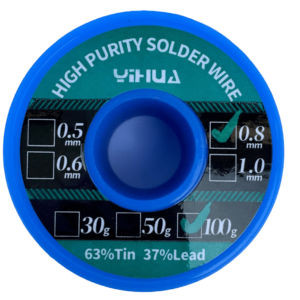
Sn99.3 / Cu0.7 | Melts around 227°C | Rosin core | 0.8 mm or 1 mm | 100 g
Sn99.3/Cu0.7 is the standard lead-free alloy for general electronics: 99.3% tin, 0.7% copper, with a rosin flux core. If what you are building is going to be sold, RoHS applies and this is what you use.
It asks a bit more of you than leaded solder. It melts around 227°C rather than 183°C, so the iron goes up to 320-360°C, and it does not wet quite as eagerly. The joints come out duller too, which is normal for lead-free and not a sign of a cold joint.
Which Diameter Should You Buy?
| Diameter | Use it for |
|---|---|
| 0.8 mm most people | General electronics, through-hole, most surface-mount, connectors. If you are buying one reel, buy this one. |
| 1 mm | Heavier joints, thicker wire, terminals and anything tied to a ground plane, where you want to deliver solder faster. |
The rule of thumb is to match the wire roughly to the pad, not to the job you did last week. Too thick and you flood a fine joint. Too thin and you sit there feeding wire into a big one while the heat spreads where you do not want it.
Lead-Free or Leaded?
Worth being clear about the trade, because lead-free is harder to learn on.
| 63/37 leaded | Sn99.3/Cu0.7 lead-free | |
|---|---|---|
| Melting point | 183°C, eutectic | Around 227°C |
| Plastic phase | None | Present |
| Iron temperature | 280-320°C | 320-360°C |
| Ease of use | Easier, flows and wets readily | Needs more heat and more patience |
| Joint appearance | Bright and shiny | Duller, which is normal not a fault |
| RoHS / commercial resale | No | Yes |
If the work is for you, leaded 63/37 is easier and more forgiving. If it is going out of the door commercially, this is the one. A lot of benches keep both.
Getting Good Joints With It
- Run the iron at 320-360°C. Lead-free needs the extra heat, and under-heating is the usual cause of the poor joints people blame on the wire.
- Expect a duller finish. Lead-free joints are matt rather than shiny. That is the alloy, not a cold joint.
- Give it a moment longer. It wets less eagerly than leaded, so let the joint come up to temperature properly before feeding wire.
- Use a tip with some mass. Fine conical tips struggle at these temperatures. A chisel transfers heat far better.
Tip wear is faster at lead-free temperatures, which is worth knowing if you are buying replacement tips at the same time.
Specifications
| Specification | Details |
|---|---|
| Alloy | Sn99.3 / Cu0.7, 99.3% tin and 0.7% copper |
| Melting point | Around 227°C |
| Flux | Rosin core |
| Diameters | 0.8 mm and 1 mm |
| Reel weight | 100 g |
| Density | Approximately 7.31 g/cm³ |
| Shear strength | 28 N/mm² at 20°C, 21 N/mm² at 100°C |
| Recommended iron temperature | 320°C to 360°C |
| RoHS | Yes, lead-free |
Frequently Asked Questions
Why do my lead-free joints look dull?
Because lead-free joints are dull. Sn99.3/Cu0.7 sets with a matt, slightly grainy surface where leaded solder goes bright and shiny. It is the alloy, not a cold joint. Judge the joint by its shape instead: you want a concave fillet that has wet properly onto both the pad and the lead.
What temperature does lead-free solder need?
Set the iron between 320 and 360°C. The alloy melts around 227°C, but you need headroom above that to heat the joint quickly rather than slowly cooking it. Running too cool is the most common reason people find lead-free difficult.
What diameter should I buy?
0.8 mm covers most electronics work, from through-hole to surface-mount. Choose 1 mm for heavier joints, thick wire and ground planes where you want to deliver solder faster. If in doubt, 0.8 mm.
Do I need different tips for lead-free?
Not different tips, but expect them to wear faster because you are working hotter. A chisel tip with some thermal mass will serve you far better than a fine conical one at these temperatures.
When do I actually have to use lead-free?
When the product is being sold. RoHS restricts lead in commercial electronics sold in the UK and EU. For your own repairs, prototypes and hobby projects, leaded 63/37 is legal and easier to work with.