

A strong solder joint comes down to four things: clean surfaces, the right heat, enough but not too much solder, and holding still while it cools. Whether you are soldering electronic components to a circuit board (PCB) or joining electrical wires, get those right and the joint is shiny, smooth and reliable for decades. This guide shows you what a good solder joint looks like, how strong solder really is, and the tips and tricks for soldering electronics properly, every joint a good one.
The short version
Heat the joint, not the solder. Touch the solder to the heated pad and pin so it melts and flows into a smooth, shiny, concave fillet that wets both surfaces. Use just enough solder, then keep the joint still for a second or two as it sets. Clean metal and good flux do most of the work.
What Does a Good Solder Joint Look Like?
A good solder joint is easy to recognise once you know the signs. It should be:
- Shiny and smooth, with an even surface (leaded solder is bright; lead-free is slightly duller but still smooth).
- Concave, forming a small "volcano" or fillet that curves up around the component lead.
- Fully wetted, flowing onto and bonding with both the pad and the lead, not sitting on top as a ball.
- The right amount, enough to cover the pad and form a fillet, with the lead still visible through it.
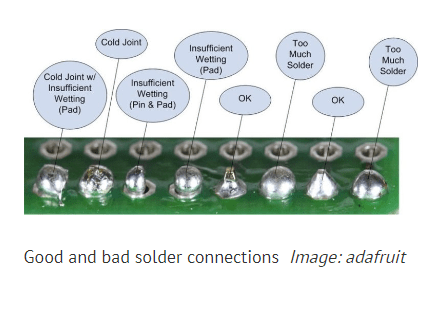
A bad joint looks the opposite: dull and grainy (a cold joint), a round blob sitting on top (too much solder or poor wetting), spiky, cracked or with the pad barely covered. If it does not look smooth and shiny, reflow it.
How Strong Is Solder (and a Solder Joint)?
Solder itself is a relatively soft metal. Tin-lead and lead-free alloys have a tensile strength in the region of 30 to 50 MPa, far weaker than the copper and steel they join. So solder is not a structural glue, you should not hang weight off a soldered joint.
What matters is that a properly made solder joint is more than strong enough for its job: holding an electronic component on the circuit board and carrying its electrical connection reliably for years. The strength comes from the solder wetting and bonding to both metal surfaces (forming an intermetallic layer), not from the size of the blob.
More solder is not stronger
A common myth. A big blob is weaker, not stronger, because the joint relies on a thin, well-wetted bond, not bulk. For joints under real mechanical stress (like wires that flex), add mechanical support such as a crimp or a hook, then solder.
This video shows what separates a strong joint from a weak one:
The Keys to a Strong Solder Joint
Almost every strong joint comes from the same handful of fundamentals:
- Clean surfaces. Oxide and grease stop solder wetting. Start with clean pads, clean leads and a clean, tinned tip.
- Good flux. The rosin core in your solder cleans the metal as it heats. For old or oxidised joints, add extra flux.
- Heat the joint, not the solder. Warm the pad and lead with the iron, then feed solder onto the joint so it melts and flows in.
- The right temperature. Hot enough to flow in one to three seconds. See the temperature guide.
- The right amount of solder. Enough for a fillet, no more. The right solder wire (0.8mm rosin-core) makes this easy.
- Hold still while it cools. Movement during cooling makes a frosty, weak joint. Keep everything steady for a second or two.
How to Make a Strong Solder Joint (Step by Step)
This is the core technique for soldering electronics properly, whether you are fixing a circuit board or making an electrical connection between wires:
- Prepare and clean. Make sure the pad, lead and tip are clean. Tin the tip with a little fresh solder so it transfers heat well.
- Heat the joint. Place the iron so it touches both the pad and the lead at once, and hold for a moment to bring both up to temperature.
- Feed the solder. Touch the solder wire to the joint (not the tip) so it melts and flows around the pad and lead into a smooth fillet.
- Remove the solder, then the iron. Pull the wire away first, then lift the iron, leaving a clean concave joint.
- Let it cool undisturbed. Do not move the joint for a second or two. Inspect: it should be shiny, smooth and concave.
A clear walkthrough of the technique from start to finish:
Bad Solder Joints and How to Avoid Them
Most weak joints fall into a few familiar types. Here is what causes each and the fix:
| Problem | Cause | Fix |
|---|---|---|
| Cold joint (dull, grainy) | Not enough heat, or moved while cooling | Reheat fully until shiny, hold still |
| Dry joint (not wetted) | Dirty surface or no flux | Clean, add flux, reflow |
| Blob / ball | Too much solder, poor wetting | Remove excess, reflow with flux |
| Bridge (joins two pads) | Too much solder between pins | Remove with a solder sucker or braid |
| Starved joint | Too little solder | Add a little more to form a fillet |
When in doubt, add a little flux and reflow. Most bad joints come good with clean metal, fresh flux and enough heat.
The Role of Flux
Flux is the unsung hero of a strong joint. As it heats, it strips the oxide off the metal so the molten solder can wet the surface and bond to it. That is why electronics solder has a rosin flux core, and why you should never sand or scrape a joint instead.
For tired, oxidised or stubborn joints, a dab of extra flux makes solder flow where it would not before. Use rosin or no-clean flux for electronics, never acid or plumbing flux. See soldering supplies and spares.
Frequently Asked Questions
What does a good solder joint look like?
Shiny, smooth and concave, forming a small fillet that wets both the pad and the lead. The lead should still be visible through the solder. A dull, grainy, blobby or cracked joint is a bad one and should be reflowed.
How strong is a solder joint?
Solder is a soft metal (around 30 to 50 MPa tensile strength), weaker than the metals it joins, so it is not for load-bearing. But a properly made joint is easily strong enough to hold a component and carry its signal reliably for decades.
Does more solder make a stronger joint?
No. A big blob is actually weaker. Strength comes from the solder wetting and bonding to both surfaces in a thin fillet, not from bulk. Use just enough to form a clean fillet.
Why do my solder joints look dull or cracked?
Usually a cold joint: too little heat, or the joint moved while cooling. Reheat until the solder flows shiny and smooth, then hold everything still for a second or two as it sets.
How do you make a strong solder joint?
Clean the surfaces, heat the joint (not the solder), feed enough solder to form a smooth concave fillet that wets both parts, then let it cool without moving. Clean metal, good flux and the right temperature do the rest.
What does flux do?
Flux removes oxide from the metal as it heats so the solder can wet and bond properly. It is built into electronics solder as a rosin core, and extra flux helps on oxidised or difficult joints.