

WiFi Modules for IoT - Wireless Connectivity Solutions
Browse our selection of Wi-Fi modules engineered for Internet of Things applications. From popular ESP8266 and ESP32 platforms to specialized low-power 802.11 modules, we stock wireless connectivity solutions for embedded systems, sensor networks, and connected devices. These modules support standard communication interfaces (UART, SPI, I2C) and operate in 2.4GHz and 5GHz frequency bands, enabling rapid integration into microcontroller and development board projects. Whether you’re prototyping smart home devices, industrial monitoring systems, or remote sensor networks, find the Wi-Fi module that matches your power budget and performance requirements.
Showing all 4 resultsSorted by price: high to low
- Price range: £5.90 through £9.90Select options This product has multiple variants. The options may be chosen on the product page
 £4.90Select options This product has multiple variants. The options may be chosen on the product page
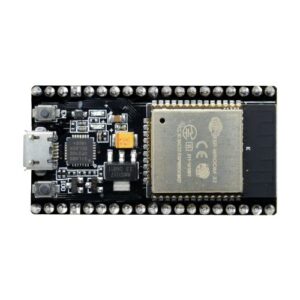
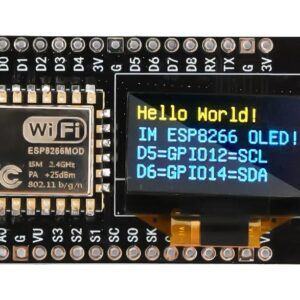
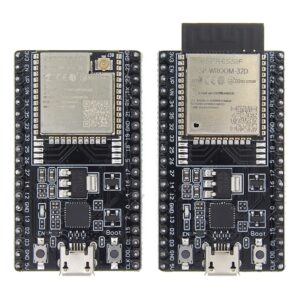
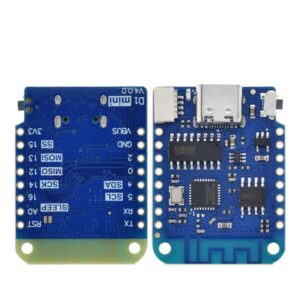
Showing all 4 resultsSorted by price: high to low
Selecting the Right Wi-Fi Module for Your IoT Application
Module selection begins with evaluating power consumption requirements. Battery-operated IoT devices demand ultra-low-power modules capable of deep sleep modes consuming microamps, waking periodically to transmit sensor data. The ESP8266 draws approximately 80mA during active transmission but achieves sleep currents below 20µA with proper configuration. ESP32 modules offer similar power profiles with additional Bluetooth capability, making them suitable for dual-protocol applications. Mains-powered devices have less stringent power constraints, allowing selection based primarily on performance and feature requirements.
Communication interface compatibility critically affects integration effort. UART interfaces provide the simplest integration path, requiring only RX, TX, and ground connections for basic AT command communication. This approach offloads TCP/IP stack management to the module itself, reducing host MCU complexity. SPI and SDIO interfaces deliver higher data throughput—essential for applications like video streaming or frequent large-payload transfers—but require more complex driver implementation. I2C offers a middle ground with moderate speeds and minimal pin requirements, though fewer Wi-Fi modules support this interface natively.
Frequency band selection impacts both range and data rate. The 2.4GHz band provides superior wall penetration and longer range, making it ideal for indoor IoT deployments where devices may be distributed across multiple rooms or floors. However, 2.4GHz suffers from congestion in dense wireless environments due to competing devices and overlapping channels. Dual-band modules supporting both 2.4GHz and 5GHz operation offer flexibility—5GHz provides higher data rates with reduced interference but shorter effective range. For most IoT sensor applications transmitting small periodic payloads, 2.4GHz 802.11b/g/n modules suffice.
Protocol Standards and Performance Characteristics
802.11b operates exclusively at 2.4GHz with maximum theoretical speeds of 11Mbps. While considered legacy, its robust modulation scheme provides excellent range characteristics—relevant for outdoor sensor networks or applications requiring maximum coverage distance. Modern modules rarely implement 802.11b exclusively, but dual/triple-mode modules maintain backward compatibility.
802.11g improved upon 802.11b with OFDM modulation, achieving 54Mbps at 2.4GHz while maintaining compatibility with 802.11b devices. This standard represents the minimum capability for contemporary IoT modules, balancing adequate data rates with proven reliability for home automation, environmental monitoring, and smart metering applications.
802.11n (Wi-Fi 4) introduced MIMO (Multiple Input Multiple Output) technology and channel bonding, enabling speeds up to 600Mbps depending on implementation. Operating in both 2.4GHz and 5GHz bands, 802.11n modules suit applications requiring video transmission, real-time audio streaming, or frequent firmware updates. The ESP32 family implements 802.11n, providing substantial performance headroom for complex IoT applications.
802.11ac (Wi-Fi 5) and 802.11ax (Wi-Fi 6) target high-performance applications, offering gigabit speeds and improved efficiency in dense deployment scenarios. These standards remain less common in embedded IoT modules due to increased power consumption and complexity, though newer chipsets like ESP32-C6 and ESP32-S3 begin incorporating these capabilities for next-generation applications.
Integration Considerations for Embedded Systems
Host MCU selection significantly influences module choice. Low-power microcontrollers like STM32L series or AVR-based platforms pair well with UART-based modules using AT commands, as the Wi-Fi module handles network stack complexity independently. More powerful processors can leverage SPI-connected modules, implementing TCP/IP stacks directly for finer control over network behavior and potentially lower system costs. Many developers choose WeMos D1 Mini boards that integrate ESP8266 modules with USB programming interfaces, significantly accelerating prototyping and development workflows.
Antenna configuration affects both cost and performance. Modules with integrated PCB antennas minimize BoM costs and simplify mechanical design but typically sacrifice range compared to external antenna options. Applications requiring extended coverage—outdoor sensors, building-to-building links, or installations in RF-challenging environments—benefit from modules offering U.FL or IPEX connectors for external antenna attachment. Some modules provide antenna diversity, automatically selecting between PCB and external antennas based on signal quality.
Certification status determines time-to-market and regulatory compliance costs. Pre-certified modules (FCC, CE, IC) allow designers to leverage modular approval pathways, significantly reducing certification costs and testing time compared to implementing raw Wi-Fi chipsets on custom PCBs. This advantage proves particularly valuable for small production runs or rapid prototyping where full regulatory testing represents prohibitive expense.
Common IoT Application Scenarios
Smart Home and Building Automation
Wi-Fi modules enable direct cloud connectivity for thermostats, lighting controls, security sensors, and appliances. The 2.4GHz band’s excellent building penetration ensures reliable connectivity throughout residential and light commercial structures. Modules supporting WPA2/WPA3 encryption protect against unauthorized access, while OTA (Over-The-Air) firmware update capabilities allow post-deployment security patches and feature additions.
Industrial Monitoring and Control
Manufacturing environments leverage Wi-Fi modules for machine health monitoring, production line control, and inventory tracking systems. Industrial applications often require extended temperature ranges (-40°C to +85°C), vibration tolerance, and sustained data throughput for real-time control loops. Modules with industrial-grade specifications and proven EMI/EMC compliance suit these demanding deployments. Integration with communication boards enables multi-protocol systems combining Wi-Fi with RS485, CAN bus, or other industrial interfaces.
Environmental and Agricultural Sensing
Battery-powered outdoor sensors for weather monitoring, soil moisture tracking, and air quality measurement depend on ultra-low-power Wi-Fi modules capable of years-long operation from battery sources. These applications typically transmit small data packets (tens to hundreds of bytes) at infrequent intervals, making power-optimized modules with efficient sleep modes essential. ESP-based modules excel in these scenarios due to their flexible power management and widespread library support.
Related Components and Development Tools
Successful Wi-Fi module integration requires supporting components and tools. Electronic components including voltage regulators, antenna matching networks, and decoupling capacitors ensure stable module operation. Wi-Fi modules often require clean 3.3V supplies capable of delivering peak currents during transmission—typically 200-400mA depending on module and transmission power.
Development and debugging benefit significantly from proper tooling. Signal integrity verification proves critical when troubleshooting communication issues between host MCU and Wi-Fi module. For permanent installations, quality soldering stations ensure reliable connections, particularly for modules using castellated mounting holes or fine-pitch surface mount pads requiring reflow techniques.
Antenna installation in enclosures demands careful consideration. Conductive enclosures require antenna placement near plastic windows or external mounting to avoid shielding. Ground plane design affects antenna performance—modules with PCB antennas require specific keep-out zones specified in datasheets. Testing RF performance with a Wi-Fi analyzer or spectrum analyzer validates installation before deployment.
Frequently Asked Questions
Where to buy Wi-Fi modules for IoT?
Kunkune offers an extensive range of Wi-Fi modules suitable for IoT development, including popular ESP8266 and ESP32 platforms alongside specialized low-power modules from leading manufacturers. Their inventory covers modules with various interface options (UART, SPI, I2C), frequency bands (2.4GHz, dual-band), and form factors to accommodate different project requirements. UK-based engineers and hobbyists benefit from local stock availability, detailed technical specifications, and fast delivery times. The selection includes both pre-certified modules for commercial applications and development boards ideal for prototyping and learning IoT connectivity fundamentals.
What’s the difference between ESP8266 and ESP32 modules?
ESP8266 provides basic Wi-Fi connectivity (802.11 b/g/n) at 2.4GHz with integrated TCP/IP stack, suitable for simple IoT applications requiring only Wi-Fi. ESP32 represents a more capable successor, offering dual-core processing (up to 240MHz), Bluetooth 4.2/BLE in addition to Wi-Fi, more GPIO pins, hardware encryption accelerators, and additional peripheral interfaces. ESP32 consumes slightly more power but provides substantially greater processing capability for applications requiring local data processing, multiple simultaneous connections, or dual-protocol operation. For basic sensor-to-cloud applications, ESP8266 suffices; complex applications with local intelligence benefit from ESP32’s enhanced capabilities.
Do Wi-Fi modules work with Arduino and Raspberry Pi?
Yes, Wi-Fi modules integrate with both platforms through standard interfaces. Arduino boards connect via UART (Serial), SPI, or software serial, with libraries available for popular modules like ESP8266 and ESP32. Many modules support AT command sets for simplified Arduino integration. Raspberry Pi offers multiple connection options—USB adapters provide plug-and-play functionality, while GPIO-connected modules via UART or SPI enable headless operation. Pre-configured libraries in Arduino IDE and Python simplify development, abstracting low-level communication details for rapid prototyping.
What interface should I choose: UART, SPI, or I2C?
UART suits applications prioritizing simplicity over speed, providing straightforward integration with AT command-based modules. Maximum practical speeds typically reach 115200-921600 baud, adequate for most IoT sensor data transmission. SPI delivers higher throughput (10+ Mbps) necessary for applications like video streaming, firmware updates, or frequent large payload transfers, but requires more complex implementation. I2C offers moderate speeds with minimal pin count, though fewer Wi-Fi modules support this interface. For basic IoT applications transmitting small periodic payloads, UART provides the best integration effort-to-functionality ratio.
How much power do Wi-Fi modules consume?
Power consumption varies dramatically between operational modes. Active transmission typically draws 80-170mA at 3.3V (depending on transmit power settings), while receive mode consumes 50-80mA. Deep sleep modes reduce consumption to 10-100µA, critical for battery-operated applications. Total system power depends on duty cycle—a sensor transmitting 100 bytes every 10 minutes can achieve months or years of battery life by spending >99% of time in deep sleep. Applications requiring continuous connectivity (real-time control, video streaming) demand mains power or substantial battery capacity. Module datasheets specify power consumption across operational modes, enabling accurate battery life calculations.
Are Wi-Fi modules pre-certified for regulatory compliance?
Many modules offer modular certification (FCC, CE, IC), allowing manufacturers to leverage simplified approval processes for end products. Pre-certified modules contain integrated RF shielding and have undergone full compliance testing as standalone units. Final product certification still requires testing, but modular approval significantly reduces cost, testing scope, and time-to-market compared to certifying raw Wi-Fi chipsets integrated on custom PCBs. Modules without certification require full regulatory testing as part of the end product—suitable for prototypes but prohibitively expensive for small production volumes. Always verify certification status and regional approvals before selecting modules for commercial products.