





948DQ-I: Keep the Smoke Out of Your Face
5W | 9 mm activated carbon filter | 5-blade fan | Helping hands included | 90 × 145 × 164 mm
The smoke coming off a solder joint is vaporised flux, and breathing it for an hour at a time is the part of this hobby people quietly regret later. A bench extractor sits beside your work, pulls the plume sideways before it reaches your face, and passes it through activated carbon. This one adds a pair of helping hands to the same footprint, which is the other thing every bench needs.
What It Is, and What It Is Not
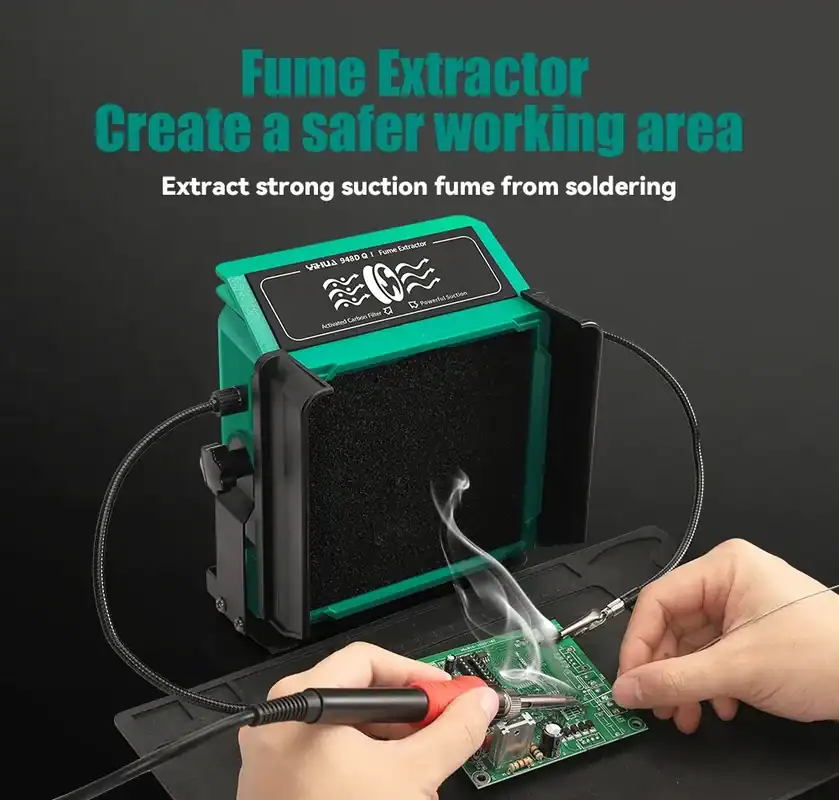
It is a 5W bench extractor with a 9 mm activated carbon panel, a five-blade fan, an adjustable stand and fenders on both sides that funnel the plume into the filter instead of letting it drift around the panel. Two flexible helping-hands arms mount on the same body.
Getting It in the Right Place
- Sit it about 10 cm from the joint. Closer and it catches the plume properly. Much further and the airflow spreads out and stops doing useful work.
- Put it to the side, not behind. You want the fumes drawn sideways across the bench, away from where your head is.
- Open the side fenders. They exist to stop the plume drifting around the filter panel rather than through it.
- Keep your head out of the rising smoke. An extractor helps, but leaning directly over the joint defeats it.
The Filter Is a Consumable
This is the part people ask about most, so here it is plainly. The 9 mm activated carbon panel is a wear item, not a permanent fitting. Carbon works by adsorption: it has a finite capacity, and once that is used up the fan is just moving smoke around.
Replace it when the airflow through the panel feels noticeably weaker, the smell starts getting past it, or the pad has gone dark and stiff. How quickly that happens depends entirely on how much you solder, so go by those signs rather than a calendar. The panel lifts out of the front frame, so changing it is a swap rather than a repair.
Protecting Yourself From Solder Fumes
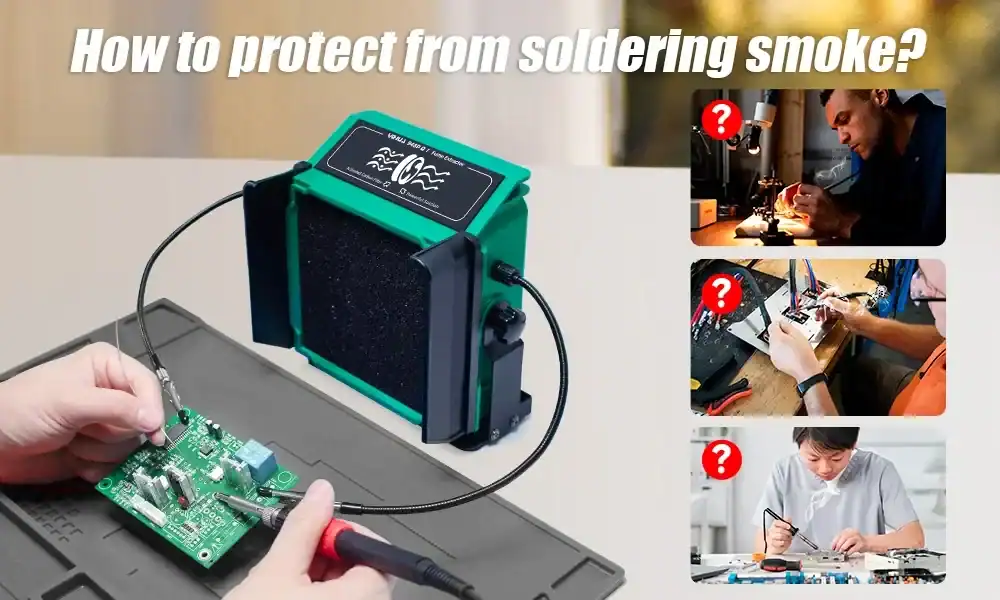
The smoke is mostly vaporised rosin flux. It is a recognised respiratory irritant, and repeated exposure is associated with occupational asthma, which is why extraction is standard practice in workshops rather than an optional extra.
Lead is a separate question. It does not vaporise at soldering temperatures, so it is not what you are inhaling. It matters through hand-to-mouth contact, which is why you wash your hands after a session and keep food off the bench.
- Extract at the source: A bench extractor beside the joint does more than a fan across the room, because it catches the plume before it disperses.
- Ventilate as well: An open window or general room ventilation works alongside extraction, not instead of it.
- Keep your head to the side: Do not lean over the work. Let the smoke rise away from your face.
- Consider lead-free: It runs hotter and behaves differently, but it removes the lead question from the bench entirely.
- Wash your hands afterwards: This is the one that actually addresses lead exposure.
- Mask up for heavy sessions: For long or professional use, an FFP2 or a respirator rated for organic vapour adds a layer that a carbon pad cannot.
Specifications
| Specification | Details |
|---|---|
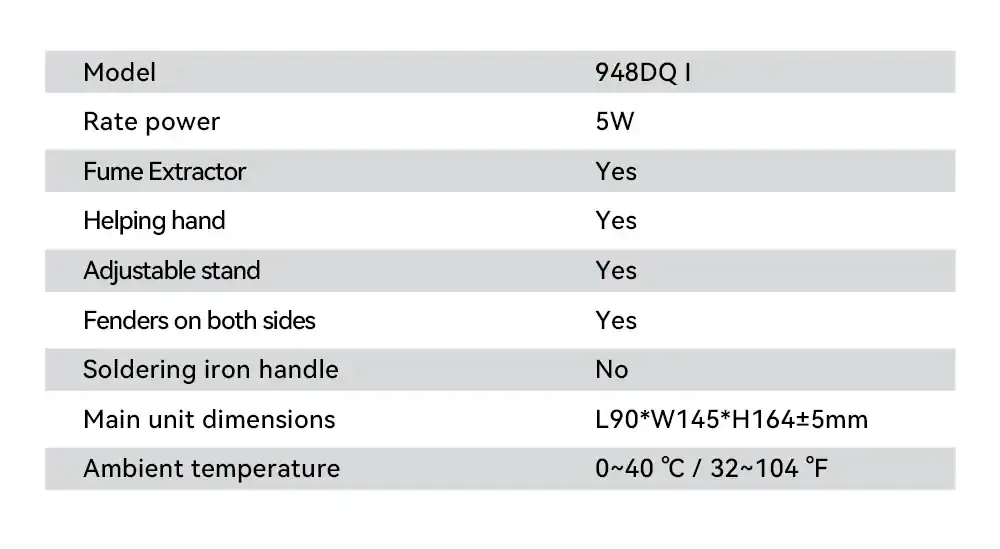
| Model | YIHUA 948DQ-I |
| Rated power | 5W |
| Filter | Activated carbon, 9 mm thick |
| Fan | 5-blade |
| Helping hands | Included, flexible arms |
| Adjustable stand | Yes |
| Side fenders | Yes, both sides, to funnel fumes into the filter |
| Soldering iron handle | No, this is an extractor only |
| Main unit dimensions | 90 × 145 × 164 mm (±5 mm) |
| Ambient temperature | 0°C to 40°C (32°F to 104°F) |
| Recommended working distance | About 10 cm from the front of the unit |
See It in Action
Frequently Asked Questions
Are soldering fumes actually harmful?
The smoke you see is mostly vaporised flux, not lead. Rosin flux fumes are a recognised respiratory irritant and repeated exposure is associated with occupational asthma, which is why extraction is standard practice in workshops rather than an optional extra. Lead does not vaporise at normal soldering temperatures, so the airborne risk is the flux. Lead matters through hand-to-mouth contact instead, which is why you wash your hands after soldering.
Does a carbon filter actually do anything?
Activated carbon adsorbs the organic vapours and the smell, which is the part that irritates your airway at a hobby bench. What it does not do is filter fine particulate the way a HEPA element would, and it does not vent anything outside the room. For occasional and hobby soldering, carbon filtration plus a cracked window is a sensible setup. For all-day production work you want ducted extraction or a HEPA plus carbon unit.
Does this come with a soldering iron?
No. The 948DQ-I is an extractor and helping-hands stand only. The manufacturer's own specification confirms there is no soldering iron handle. If you want fume extraction built into a station, that is a different product.
When do I replace the filter, and how?
The carbon filter is a consumable. Replace it when the airflow through the panel feels noticeably weaker, when the smell starts getting past it, or when the pad has gone visibly dark and stiff. How fast that happens depends entirely on how much you solder. The panel lifts out of the front frame, so it is a swap rather than a repair.
How far away should it sit?
About 10 cm from your work, with the side fenders out. Closer and it pulls the fumes before they reach you; much further and the airflow spreads out and stops doing much. The point is to catch the plume as it rises, so position it to the side of the joint rather than behind it.
Can I use it for anything other than soldering?
Yes. The same setup works for wood burning, pyrography, stained glass work and any bench task producing light smoke or fumes. Anything producing heavy dust or solvent vapour needs proper extraction, not a carbon pad.

Reviews
There are no reviews yet.