

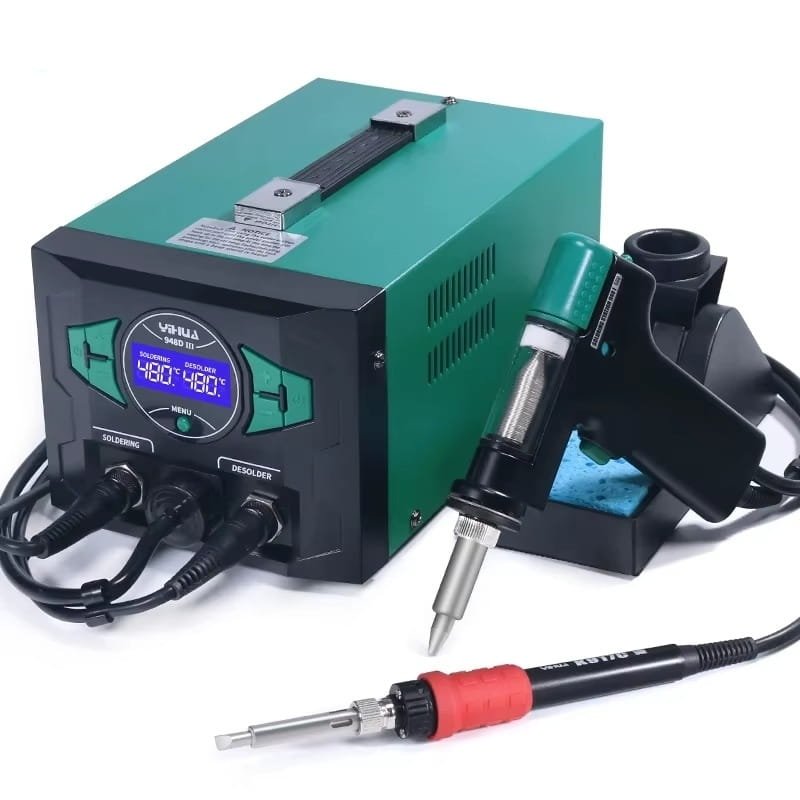
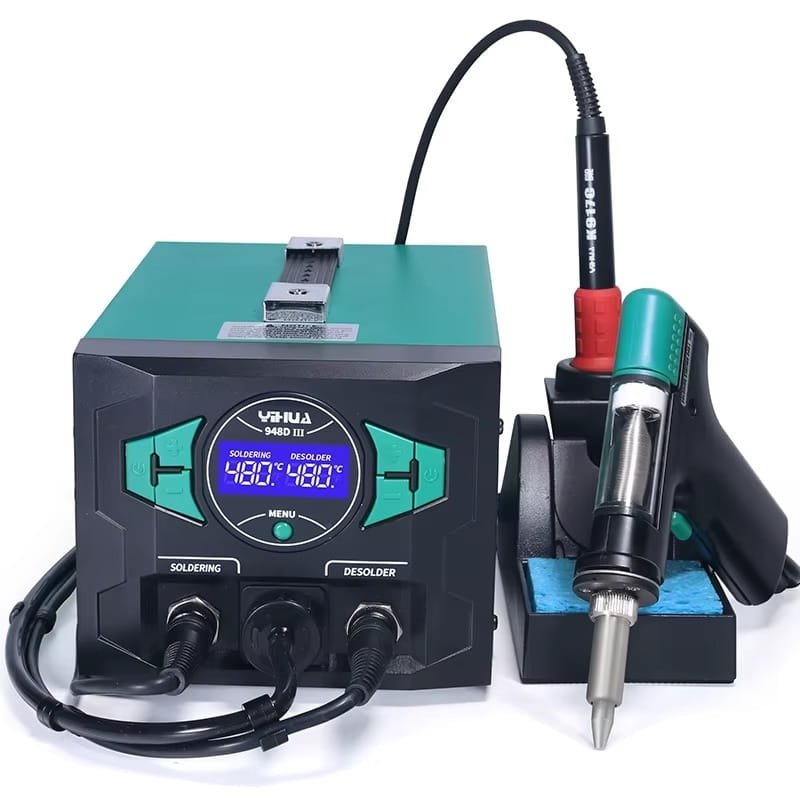
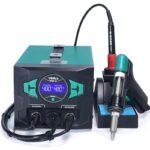
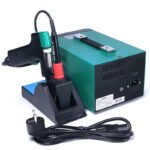


YIHUA 948D-III — 2-in-1 Soldering & Desoldering Station for PCB Repair
110W EVO Iron | Powered Vacuum Desoldering Gun | PID Temperature Control
Key Features
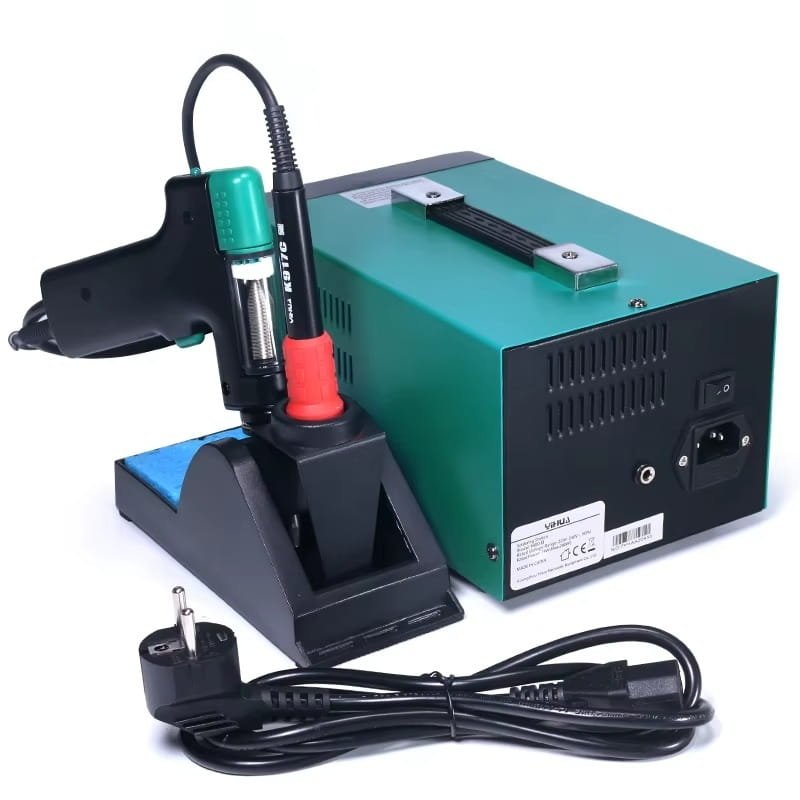
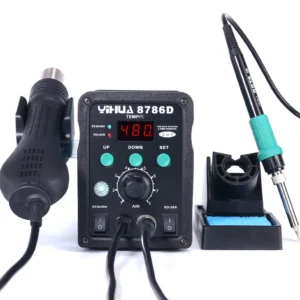
- 2-in-1 Soldering & Desoldering Station: Combines a powerful 110W EVO ceramic soldering iron with a built-in vacuum pump desoldering gun. Both tools operate simultaneously from a single compact unit — no more juggling separate tools or hunting for a second mains socket.
- 110W EVO Ceramic Heating Element: Nearly double the wattage of previous YIHUA models. Heats up fast, recovers quickly between joints, and handles lead-free solder and heavy ground planes without stalling. Temperature range: 200–480°C (392–896°F).
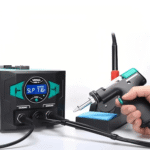
- Powered Vacuum Desoldering Gun (50 kPa): Trigger-activated suction clears through-hole pads cleanly. Transparent collection chamber for easy emptying, dual ceramic and carbon filtration, and three nozzle sizes included (0.8mm, 1.0mm, 2.0mm).
- PID Temperature Control (±2°C Accuracy): Corrects 50 times per second (20ms cycle) to hold your set temperature precisely. LCD display with °C/°F switching and user-accessible digital calibration offset.
- Safety & ESD Protection: 10-minute sleep mode, automatic shutdown on extended idle, buzzer alerts, and green/red preheat LED. ESD-safe design with <2Ω tip-to-ground resistance, <2mV tip voltage, isolation transformer, and grounding wire included.
- Ideal for Through-Hole Work: Perfect for recapping vintage electronics (Amiga, Commodore, classic Mac), arcade and pinball board repair, keyboard switch desoldering, and general hobbyist through-hole soldering. Certified CE, RoHS, and FCC.
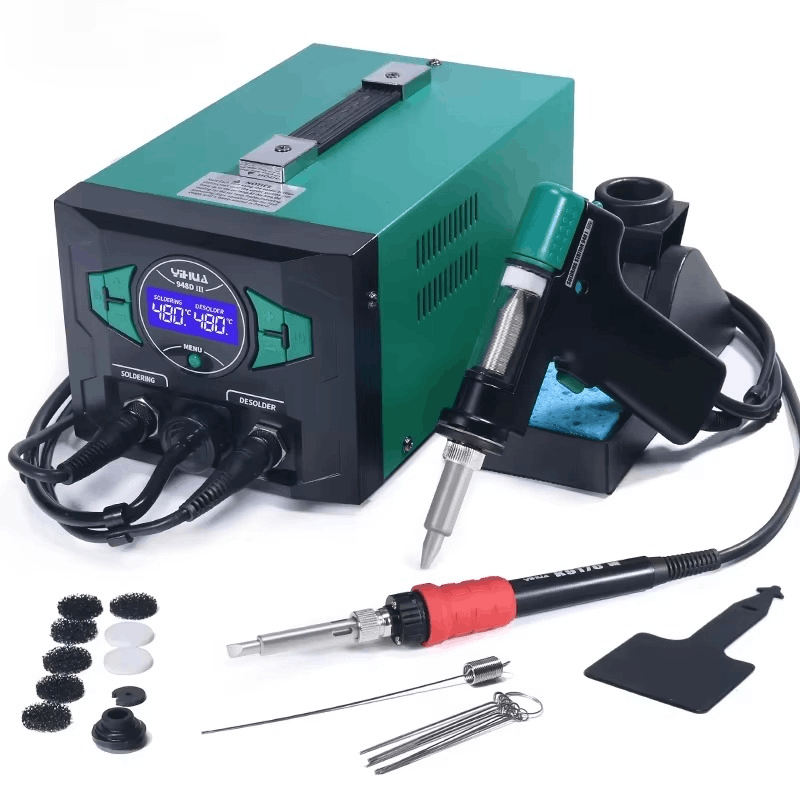
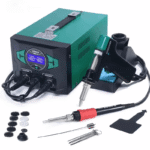
- Generous Accessory Kit Included: Comes with soldering iron handle, desoldering gun, 3 desoldering nozzles, 5 ceramic filters, 10 carbon adsorbers, cleaning pins, heat-resistant silicone pad, metallic tool holder, grounding wire, and UK power cord. Additional 902-series soldering tips recommended (sold separately).
Product Description
Why the 948D-III Exists
If you’ve ever tried to recap a vintage board with a solder sucker in one hand and a soldering iron in the other, you know the routine: heat the joint, drop the iron, grab the sucker, pump it before the solder re-solidifies, miss half the pad, repeat. It’s slow, frustrating, and occasionally destructive.
The 948D-III replaces that entire process. The desoldering gun heats and vacuums simultaneously — press the trigger and the built-in pump clears the joint while the nozzle is still on it. The soldering iron runs independently alongside it, so you can touch up joints, add fresh solder, or work on a different part of the board without switching stations. Both tools operate at the same time from one unit.
What You’re Actually Getting
Simultaneous Dual-Tool Operation. Unlike the older YIHUA 948 Upgraded (which could only run one tool at a time), the 948D-III lets you use both the soldering iron and desoldering gun simultaneously. This sounds like a small upgrade on paper, but in practice it changes your workflow entirely. Stuck multi-pin DIP IC? Heat the row from one side with the iron while pulling solder from the other with the gun. Ground plane refusing to release? Hit it with both tools at once.
110W EVO Soldering Iron. The K917C iron handle delivers 110W through a proprietary EVO ceramic heating element — nearly double the 60W bundled with the 948 Upgraded and 948-II. The extra thermal mass makes a genuine difference on lead-free solder, heavy ground connections, and boards with thick copper pours where a weaker iron simply stalls out. Temperature range runs from 200°C up to 480°C.
Powered Vacuum Desoldering Gun. The 948DG gun uses a built-in compressor-type pump to pull molten solder through the heated nozzle at 50 kPa of vacuum. Solder drops into a transparent collection chamber that pops out for easy cleaning. Three nozzle sizes come in the box (0.8mm, 1.0mm, and 2.0mm) so you can match nozzle diameter to pad size. Dual-stage filtration — ceramic element plus carbon adsorbers — keeps the pump clean and extends its working life.
PID Temperature Control. A 20ms correction cycle means the station checks and adjusts temperature 50 times per second. The result is ±2°C accuracy across the range, with an LCD display that lets you switch between °C and °F. You also get a digital calibration function — if your tip thermocouple reads differently than the display, you can offset it without opening anything up.
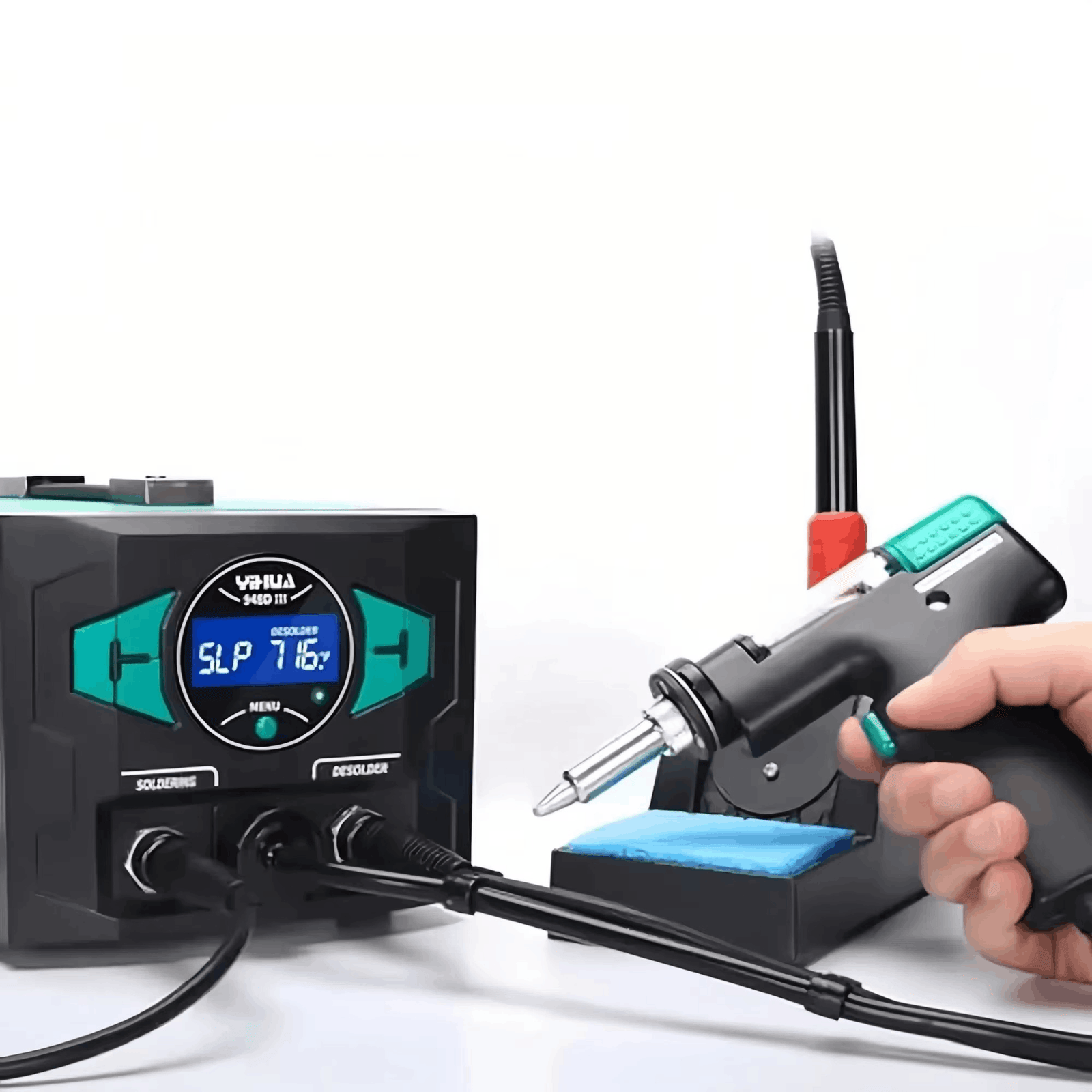
Smart Safety Features. Leave the station idle for 10 minutes and it drops into sleep mode (the display shows “SLP” and the temperature falls to a safe low). Leave it longer and it shuts off entirely. A buzzer sounds for status changes so you know what’s happening even when you’re not looking at the display, and a green/red LED shows preheat versus ready status at a glance.
Solid ESD Protection. Designed with sensitive components in mind: tip-to-ground resistance under 2Ω, tip-to-ground voltage under 2mV, an isolation transformer built in, and an external grounding wire included. If you’re working on CMOS-era boards, vintage computers, or anything with static-sensitive ICs, the ESD specs here are competitive with stations costing considerably more.
Technical Specifications
| YIHUA 948D-III — Specifications | |
|---|---|
| Station Type | 2-in-1: Soldering iron + vacuum desoldering gun |
| Rated Power | 74W nominal / 250–290W peak (both tools heating) |
| Input Voltage | AC 220–240V / 50Hz (UK plug) |
| Iron Power | 110W EVO ceramic heating element |
| Iron Temp Range | 200–480°C (392–896°F) |
| Iron Tips | 902-series (6.6mm barrel, 40mm length) — YIHUA proprietary |
| Desoldering Suction | 0.05 MPa (50 kPa) |
| Desolder Temp Range | 380–480°C (716–896°F) |
| Temperature Control | PID programmable, 20ms correction cycle (±2°C accuracy) |
| Display | LCD with °C/°F switching |
| ESD Protection | <2Ω tip-to-ground, <2mV voltage, isolation transformer |
| Dimensions | 248 × 150 × 126 mm (≈ 9.8 × 5.9 × 5.0 in) |
| Weight | ~3.1–4.4 kg unit / 5.0–6.0 kg packaged |
| Certifications | CE, RoHS, FCC, ETL, SAA, INMETRO, PSE |
What’s in the Box
- YIHUA 948D-III main station with LCD display
- K917C soldering iron handle + pre-installed 902-series chisel tip
- 948DG desoldering suction gun with trigger-activated vacuum
- 3 pre-tinned desoldering nozzles (0.8mm, 1.0mm, 2.0mm)
- 5 ceramic filters + 10 carbon filtration adsorbers
- 2 filter springs for the solder residue chamber
- Transparent solder residue collection chamber
- Stainless steel cleaning pin set
- Anti-scald heat-resistant silicone pad
- P-type metallic tool holder (heavy & stable)
- External grounding wire for ESD protection
- Silicone front cover & sealing pad for suction gun
- UK power cord & instruction manual
How It Compares
The question everyone asks: “Why not just buy a Hakko?” Fair question. Here’s the honest side-by-side.
| Anesty ZD-915 | YIHUA 948D-III | Hakko FR-301 + FX888D | |
|---|---|---|---|
| Approx. price (UK) | ~£70–90 | ~£110–230 | ~£350–420 combined |
| Soldering iron | Not included | 110W EVO ceramic | 65W (FX888D) |
| Desoldering suction | Weaker (unspecified) | 50 kPa | 81 kPa |
| Simultaneous use | N/A — no iron | ✓ Yes | ✓ Yes (two units) |
| Temp control | Basic dial | PID ±2°C, LCD | PID, digital |
| Sleep / auto-off | ✗ No | ✓ Yes | ✓ Yes (FX888D only) |
| ESD protection | Basic | <2Ω / <2mV + ground wire | Excellent |
| Tip ecosystem | Limited | 902-series (proprietary) | T18 — huge range |
| Pump noise | Moderate | Quiet | Moderate–loud |
| Units needed | 1 (desolder only) | 1 station does both | 2 separate stations |
| Best for | Tight budgets, light use | Hobbyists & moderate repair | Professionals & daily heavy use |
The Hakko combo is the gold standard — no argument there. Stronger suction, more durable, and a massive tip ecosystem built over decades. If you desolder boards all day, the Hakko pays for itself. But if you’re a hobbyist, tinkerer, or small-shop repair tech handling moderate volume, the 948D-III delivers roughly 70–80% of the capability at less than half the combined cost — and you only need one mains socket and one spot on your bench.
Within the YIHUA range, the 948-II offers more tools (adding a hot air gun and suction pen) but uses a weaker 60W iron and 75W desoldering gun. It trades depth for breadth. The 948D-III goes the other direction: fewer tools, but meaningfully stronger at the two that matter most for through-hole work.
Best Use Cases
Here’s where the 948D-III earns its keep — and where you’d be better off looking elsewhere.
| Use case | Typical tasks | Suitability | Why |
|---|---|---|---|
| Vintage electronics restoration | Recapping Amigas, Commodores, classic Macs, old audio gear, CRT monitors | Sweet spot — exactly what it’s built for | |
| Arcade & pinball repair | Pulling failed caps, replacing DIP sockets, fixing burnt connectors on game boards | Powered vacuum is dramatically faster than manual suckers | |
| Keyboard switch desoldering | Removing switches from PCBs for swaps, mods, and hot-swap conversions | 110W handles lead-free solder on ground pads without stalling | |
| General through-hole soldering | Kit building, prototyping, component-level repairs, hobby PCB assembly | Strong iron, PID control, and good ESD protection | |
| Small repair shop (moderate volume) | Customer board repairs, recap services, component swaps — a few hours per day | One station covers both jobs; cost-effective vs. separate Hakko units | |
| Electronics students & learners | Learning to solder, practising desoldering, college/uni lab work | Affordable entry to proper tooling with safety features built in | |
| Heavy-volume professional desoldering | Production lines, 8+ hours/day continuous desoldering, industrial rework | Consider Hakko FR-301 or FR-410 for stronger suction and industrial durability | |
| SMD / BGA rework | Phone and tablet repair, reflowing surface-mount components, reballing | No hot air gun — use YIHUA 853D, 862BD+, or a dedicated rework station |
Maintenance Schedule
Regular upkeep keeps suction strong and extends the station’s life. Most tasks take under a minute.
| When | Task | How & why |
|---|---|---|
| Every session | Clean desoldering nozzle | Push the included stainless steel pin through the nozzle while warm to clear residual solder. Prevents blockages mid-job. |
| Every session | Wipe soldering iron tip | Use a damp sponge or brass wool before putting the iron away. Re-tin the tip with a small blob of solder to prevent oxidation. |
| Every session | Empty solder residue chamber | Twist off the transparent chamber and dump collected solder. A full chamber restricts airflow and weakens suction. |
| Weekly | Inspect ceramic filter | Remove the white ceramic filter and check for heavy discolouration or clogging. If airflow is restricted, replace it. Spares: YIHUA #948CF. |
| Weekly | Check carbon adsorbers | If the black carbon filters look saturated or crumbly, swap them out. Kit includes 10; replacements: YIHUA #948CF (20-piece set). |
| Monthly | Deep-clean nozzle & barrel | Remove nozzle, soak in isopropyl alcohol for 10 minutes, clear internal barrel with cleaning pins. Test suction before next use. |
| Monthly | Inspect seals & O-rings | Check silicone sealing pad and vacuum cover for cracks. A thin layer of vacuum grease on rubber seals helps maintain a tight fit. |
| As needed | Replace soldering iron tip | When the tip becomes pitted or won’t tin properly. Use 902-series tips only. Recommended: YIHUA #1401 six-piece set. |
| As needed | Replace desoldering nozzle | If the opening is visibly enlarged or solder leaks around the seal. Spares: YIHUA #948DN (4-piece set). |
| As needed | Calibrate temperature | Use a tip thermometer to check actual vs. displayed temperature. Adjust using the station’s built-in digital calibration offset. |
Frequently Asked Questions
How to use the YIHUA desoldering gun?
- Switch on the station and set the desoldering gun temperature between 380–480°C using the front panel controls. Wait for the green LED to indicate the gun has reached temperature.
- Choose the correct nozzle size for the pad you’re working on — the nozzle opening should be slightly larger than the solder pad hole. The kit includes 0.8mm, 1.0mm, and 2.0mm nozzles.
- Place the heated nozzle flat against the solder joint, making full contact with the pad. Allow a second or two for the solder to fully melt.
- Press the trigger on the gun to activate the vacuum pump. The molten solder will be sucked through the nozzle into the transparent collection chamber.
- Lift the gun away cleanly. If any solder remains, reheat and trigger again. For stubborn joints, you can use the soldering iron simultaneously from the other side to add extra heat.
- After each session, push the included cleaning pin through the nozzle while still warm to prevent blockages, and empty the solder collection chamber.
What is the temperature of the YIHUA soldering station?
The YIHUA 948D-III has two independent temperature ranges. The soldering iron operates from 200°C to 480°C (392–896°F), giving you full control from delicate low-temperature work up to lead-free soldering. The desoldering gun operates from 380°C to 480°C (716–896°F), which is the optimal range for melting and extracting solder from through-hole joints.
Both tools are controlled by PID regulation with a 20ms correction cycle, holding the set temperature to within ±2°C. You can switch the LCD display between °C and °F, and the station includes a built-in digital calibration function if you need to fine-tune accuracy against an external thermometer.
Where can I buy the YIHUA 948D-III in the UK?
In the UK, the YIHUA 948D-III is available from Kunkune — a trusted UK-based retailer stocking YIHUA soldering equipment with UK-spec power cords and fast domestic shipping. Buying from a UK seller means you get proper after-sales support, easy returns, and no surprise customs charges.
The Bottom Line
The YIHUA 948D-III doesn’t try to be everything. It does two things — solder and desolder through-hole components — and it does them well enough that most hobbyists and moderate-volume repair technicians will never need anything else for that job. The 110W iron has real power behind it, the vacuum pump is noticeably quieter than the competition, and the PID control keeps temperatures exactly where you set them.
Is it a Hakko? No. Does it need to be? For most of us, also no. One station. One socket. Both tools ready when you are.


Reviews
There are no reviews yet.