




FNIRSI LCR-P1 Auto-Identifying Component Tester
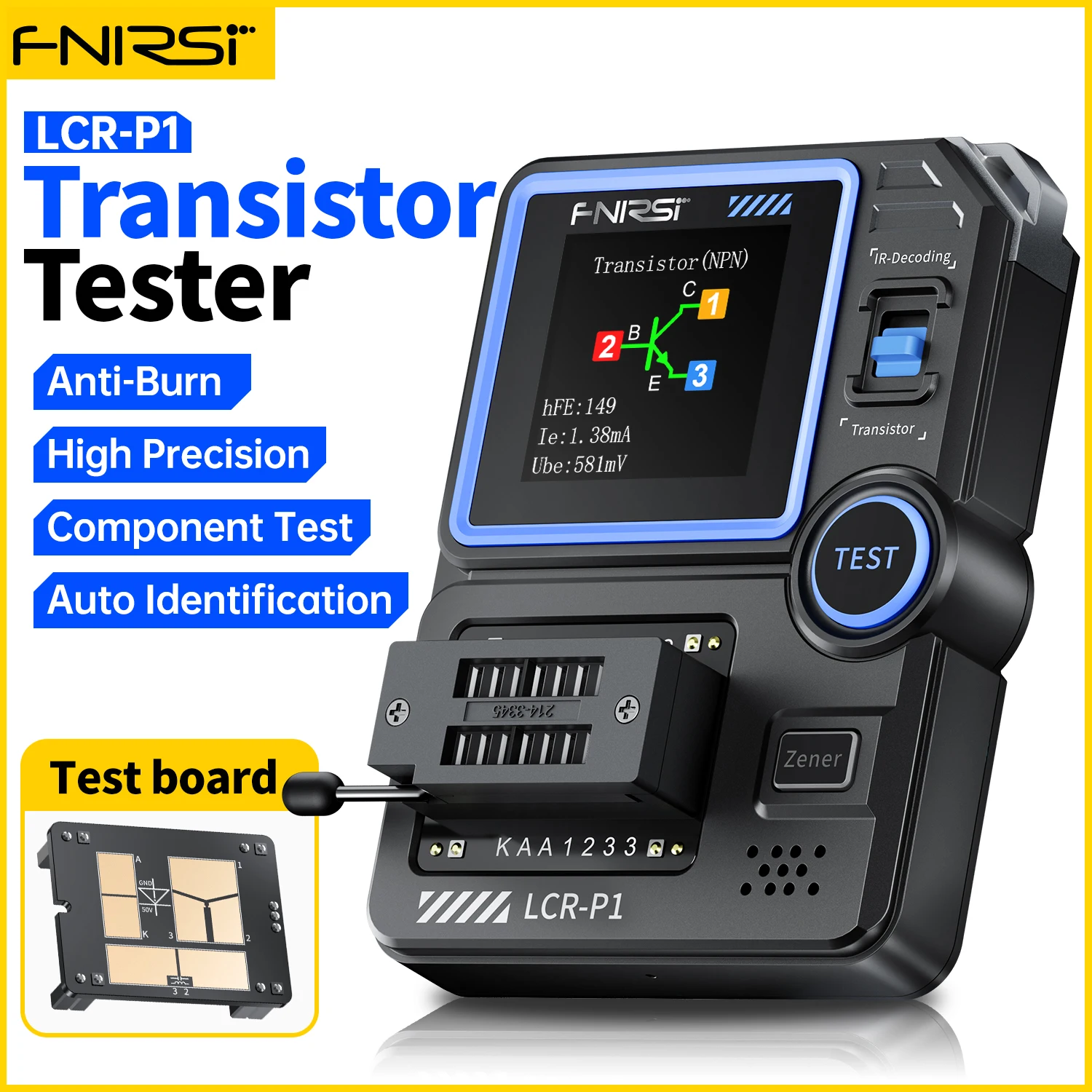
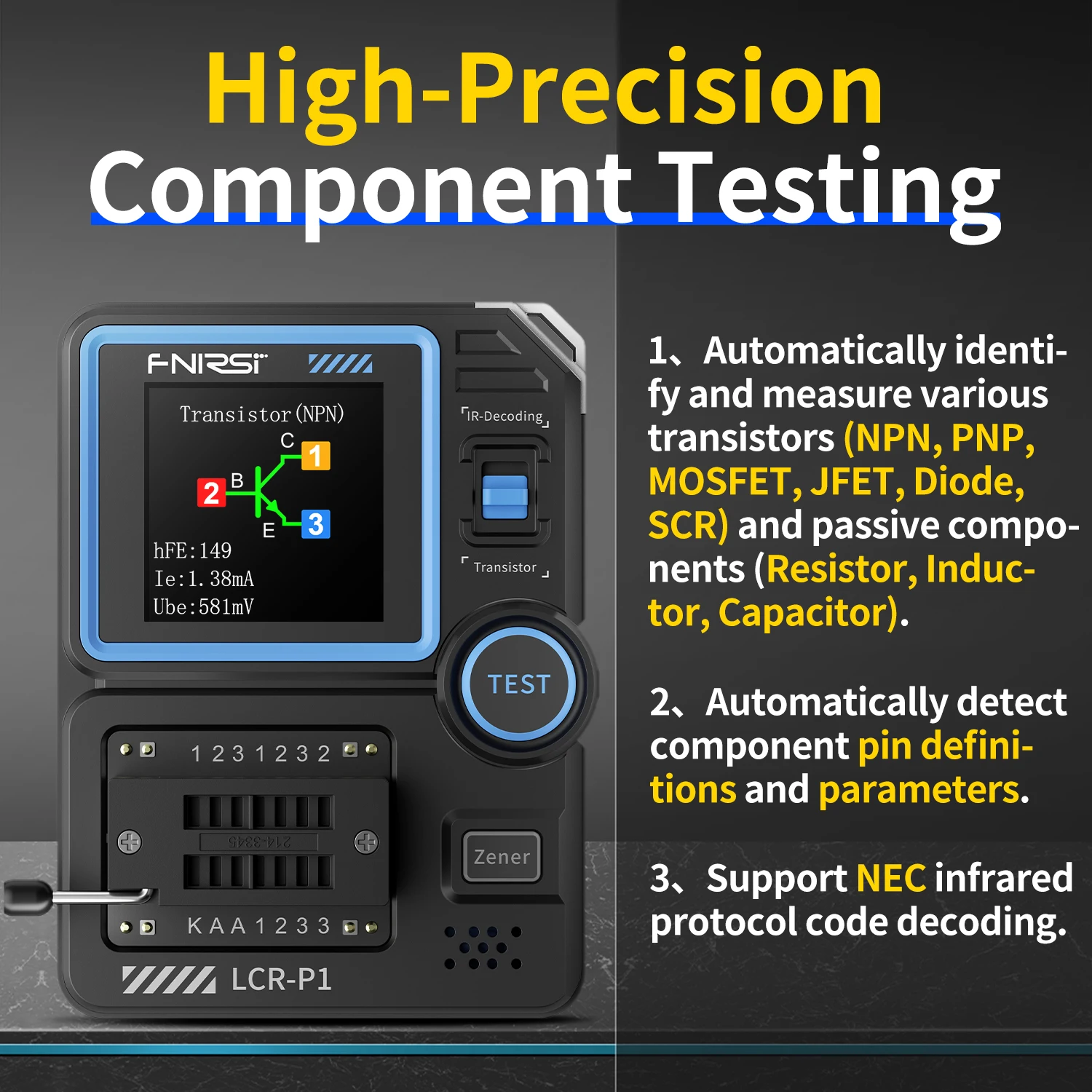
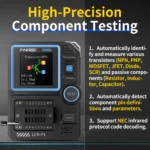
The FNIRSI LCR-P1 is an automatic component tester and MOSFET tester for UK electronics hobbyists, repair technicians, and students who need to quickly identify, pin-map, and measure unmarked or unknown electronic parts. Insert any component into the ZIF socket, press the test button, and the LCR-P1 tells you what it is, which pin is which, and its key parameters — no datasheet, no guesswork. It tests transistors (NPN/PNP/BJT), MOSFETs, JFETs, diodes, Zener diodes, capacitors, resistors, inductors, thyristors, triacs, LEDs, and batteries from a single device.
- Auto-identifies component type and pinout — insert unknown part, get type + pin assignments instantly
- Tests NPN/PNP transistors — identifies type, pinout, and measures hFE gain (range 10–600)
- Tests N/P-channel MOSFETs — pinout, threshold voltage, and RDSon
- Measures capacitance 25pF–100mF — covers SMD ceramics through large electrolytics
- Zener diode channel — measures 0.01–32V with dedicated pre-measurement power supply
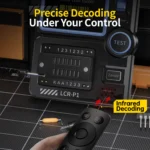
- Infrared NEC protocol decoder — tests and decodes remote control IR signals
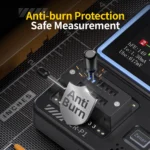
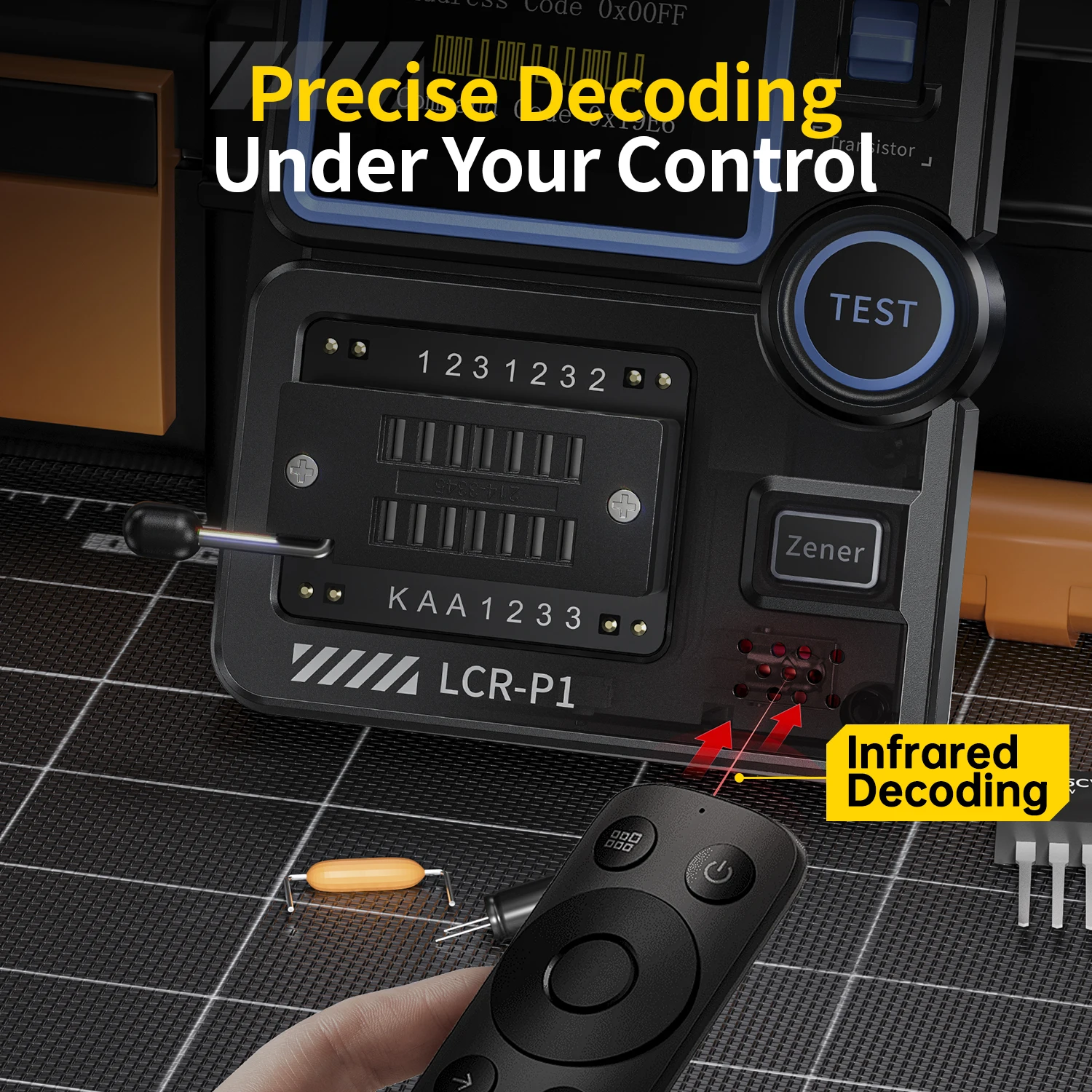
- Anti-burn protection — auto-discharges capacitors on insertion before testing
- 12-month Kunkune warranty — covered if it fails in normal use
| Specification | Value |
|---|---|
| Transistor hFE range | 10–600 |
| Capacitance range | 25pF – 100mF |
| Inductance range | 10μH – 1000μH |
| Resistance range | 0.01Ω – 50MΩ |
| Zener diode range | 0.01V – 32V |
| Display | 1.44" colour screen |
| Battery | 300mAh lithium, USB-C charging |
| Operating temperature | 0–40°C |
| Dimensions | 71 × 87 × 28mm |
What components does the LCR-P1 identify automatically?
The LCR-P1 auto-identifies and measures: NPN and PNP bipolar transistors (hFE, pinout), N-channel and P-channel MOSFETs (pinout, Vth, RDSon), JFETs, BJTs, thyristors (SCRs), triacs, standard diodes, Zener diodes (up to 32V), LEDs (with forward voltage), resistors (0.01Ω–50MΩ), capacitors (25pF–100mF), inductors (10μH–1000μH), and batteries. Insert the component and it classifies and measures without any manual mode selection.
How accurate is the transistor and MOSFET identification?
The LCR-P1 reliably identifies transistor type, base/collector/emitter pinout, and hFE for most standard NPN and PNP devices. MOSFET gate/drain/source identification and threshold voltage measurement work well on common enhancement-mode parts. One honest caveat: on some BJTs with unusual characteristics, collector-emitter pin assignment can occasionally misread — always cross-check pinout with a datasheet on critical components before soldering. For precision multi-frequency passive measurement, the FNIRSI LCR-ST2 is the right complement.
What is the infrared test function?
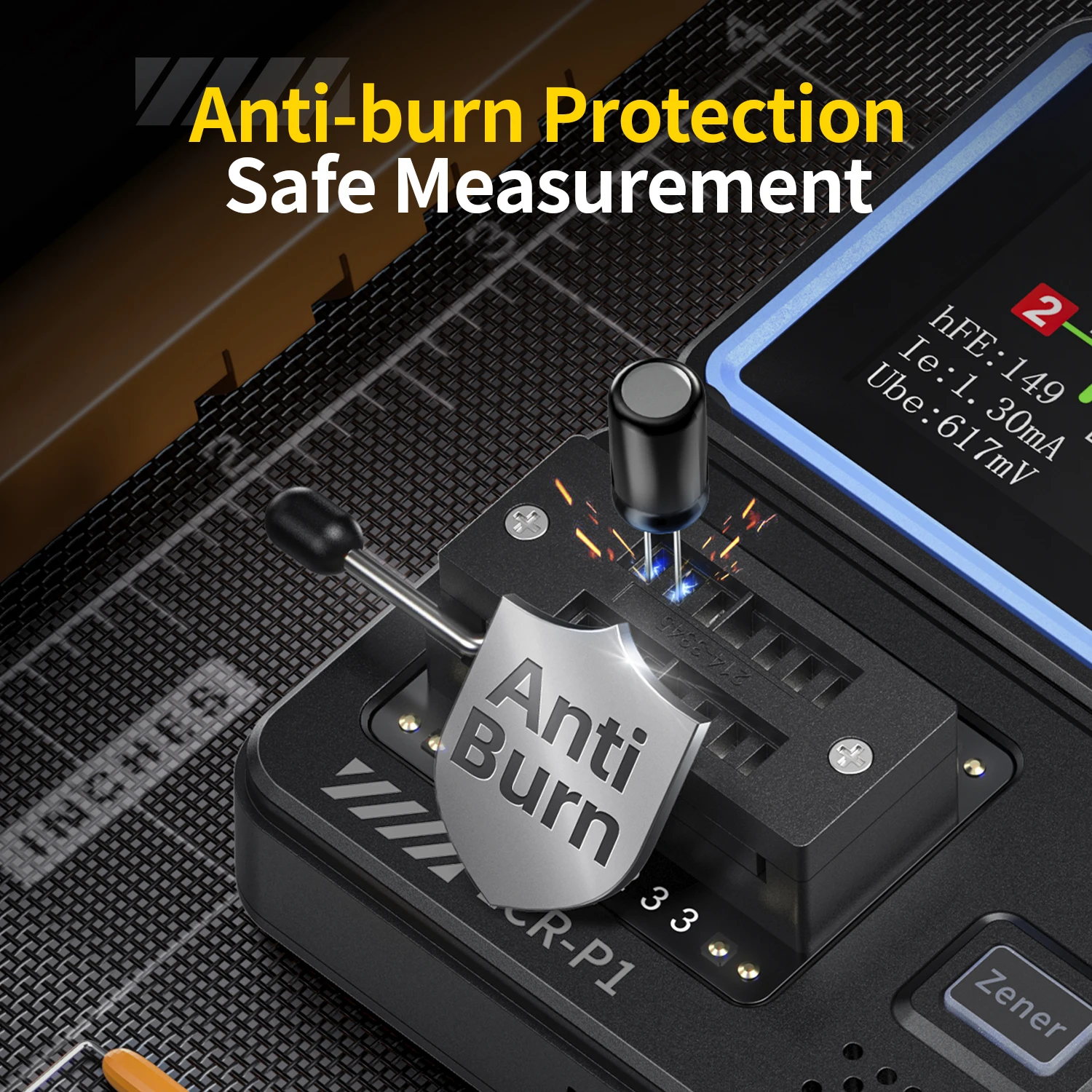
The LCR-P1 includes a dedicated infrared decoder supporting the NEC protocol — the most common IR standard used in TV remotes, set-top boxes, and consumer electronics. Point a remote at the IR sensor and the LCR-P1 displays the decoded address and command codes in real time. Useful for remote control debugging, cloning projects, and verifying IR emitter output during circuit testing.
What is the anti-burn protection and why does it matter?
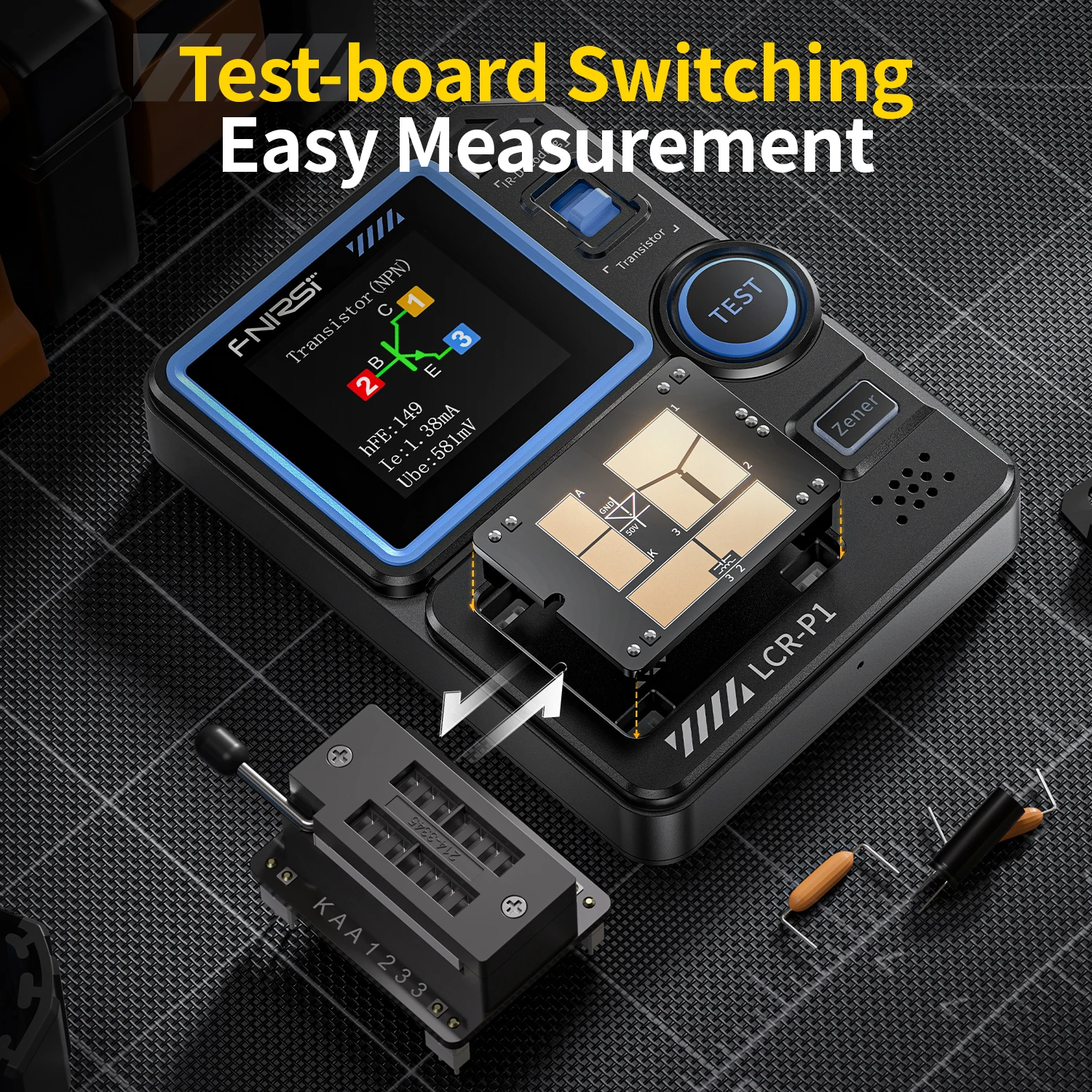
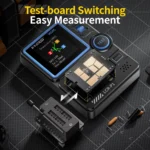
Inserting a charged capacitor into a tester without protection can destroy the measurement circuit instantly. The LCR-P1 detects and automatically discharges capacitors through a safe resistor path before applying test voltage. This works passively on insertion — you don't need to manually discharge components before testing. The replaceable test board means the ZIF socket can be swapped out if it does get damaged, rather than replacing the whole unit.
What is the difference between LCR-P1 and LCR-ST2?
The LCR-P1 is a component identifier — it tells you what an unmarked part is, what the pins are, and gives you basic parameters across a wide range of component types including active semiconductors (transistors, MOSFETs, diodes). The LCR-ST2 is a precision LCR bridge — it measures passive components (R, C, L, ESR) at five selectable frequencies with Kelvin-clip accuracy. They serve different purposes: the LCR-P1 for identifying unknowns and testing semiconductors; the LCR-ST2 for precise passive component characterisation.
Best for
Identifying unmarked or pulled transistors, MOSFETs, and diodes from salvage boards, verifying component pinouts before soldering, checking hFE gain on transistors for matched-pair circuits, testing capacitor values from unlabelled reels, measuring Zener breakdown voltage, debugging remote control IR circuits, school and college electronics labs, hobbyist component sorting and inventory checking, and repair shops identifying unknown semiconductors from Chinese boards without datasheets. Pair with the FNIRSI DSO-152 Plus for full passive and signal testing coverage.

What's In The Box
- FNIRSI LCR-P1 component tester
- Replaceable test board ×1
- Test hooks ×3
- USB-C data and charging cable
- User manual
Why Kunkune
Shipped from our Oxfordshire warehouse via Royal Mail 1–2 day delivery. 12-month warranty on all FNIRSI products. 60-day returns. No drama.
Frequently Asked Questions — FNIRSI LCR-P1
Can the LCR-P1 test SMD components?
Yes, with the included test hooks. Clip the hooks onto SMD component pads and the LCR-P1 measures the component in-circuit or on a breakout board. The ZIF socket handles through-hole and leaded parts; the hooks handle SMD. For dedicated SMD tweezer testing, the FNIRSI LCR-ST2 is better suited.
Can the LCR-P1 identify a component with no markings at all?
Yes — that's its primary purpose. Insert the component into the ZIF socket, press test, and the LCR-P1 analyses the electrical characteristics and returns the component type, pin assignments, and measured parameters. Works on most standard transistors, MOSFETs, diodes, and passives. Some unusual or very high-power devices may not be recognised.
Does the LCR-P1 measure ESR on capacitors?
No — the LCR-P1 measures capacitance value but not ESR (equivalent series resistance). For ESR testing of electrolytics, use the FNIRSI LCR-ST2 which includes ESR measurement alongside D/Q/Z parameters at multiple frequencies.
What battery does the LCR-P1 use?
A built-in 300mAh lithium cell charged via USB-C at 5V/1A. The battery is not user-removable. Charge time from flat is approximately 1–1.5 hours.
Can the LCR-P1 test high-voltage MOSFETs?
The LCR-P1 applies low test voltages to identify components safely. It identifies most enhancement-mode MOSFETs up to typical logic and signal levels. Very high-voltage or high-current power MOSFETs may need verification with a dedicated curve tracer for full characterisation, though pinout and threshold voltage are typically identified correctly.
Is the test board really replaceable?
Yes — the ZIF test socket board is a separate module that slots into the LCR-P1. If the socket wears out or gets damaged (e.g. from a charged capacitor insertion despite the protection), you can replace just the test board rather than the whole device. Replacement test boards are available separately.
Reviews
There are no reviews yet.