

Here is the thing most "best soldering iron for electronics" lists get wrong: for electronics, the best soldering iron is a temperature-controlled station, not a bare plug-in iron. Electronic components are heat-sensitive and joints are small, so you need a tip that holds an exact temperature and recovers instantly. This guide covers the best soldering irons and stations for electronics in the UK, from first Arduino builds to fine SMD, all in UK stock with a 12-month guarantee. It is part of our complete best soldering irons & stations UK guide.
The best all-round soldering iron for electronics is the YIHUA 939D+ III EVO (£69.50): 110W, PID control and a magnifier. On a budget, the YIHUA 937D+ (£39) is a proper PID iron with Hakko-compatible tips. For fine SMD, the cartridge-tipped YIHUA 982 (£68). Want one iron and a stand for under £40? The YIHUA 926LED-IV (£32.50).
UK stock · same-day dispatch before 2pm · free delivery over £25 · 12-month guarantee · 60-day returns
Why Electronics Needs Temperature Control (Not Just an Iron)
A £15 fixed-temperature iron will melt solder, but it is the wrong tool for electronics, and here is why:
- Components cook. ICs, LEDs and electrolytic capacitors are damaged by excess heat. A station holds a safe, exact temperature instead of running flat-out.
- Heat recovery makes the joint. Touch a tip to a pad and the temperature drops; a PID iron recovers in seconds, a cheap one sags, so you hold heat on the board and lift pads.
- Small joints need fine, stable tips. Electronics means 0.5 to 1mm pads, header pins and SMD. You want a fine tip that stays at temperature, not a chunky one that wanders.
- ESD matters. Static can kill a chip before you even see damage. Electronics stations are ESD-safe by design.
In short, for electronics, "soldering iron" should mean a PID station. The difference is covered in full in soldering station vs soldering iron and how to choose a soldering station.
Best Soldering Irons for Electronics, UK Picks
| Use Case | Iron / Station | Price | Why | |
|---|---|---|---|---|
| Best overall ⭐ | YIHUA 939D+ III EVO | £69.50 | 110W PID, magnifier, room to grow | Buy → |
| Best value | YIHUA 937D+ | £39 | 75W PID, Hakko 900M tips, simple | Buy → |
| Best complete kit | YIHUA 926LED-IV | £32.50 | 60W PID, helping hands, under £40 | Buy → |
| Best for SMD | YIHUA 982 | £68 | C210/C245 cartridge, 2-7s heat-up | Buy → |
| Best portable | YIHUA 928D-IV | £44.50 | USB-C cordless, 5s heat-up, field work | Buy → |
All ship from UK stock. Same-day dispatch before 2pm. 12-month guarantee. Browse all soldering stations →
The Irons in Detail
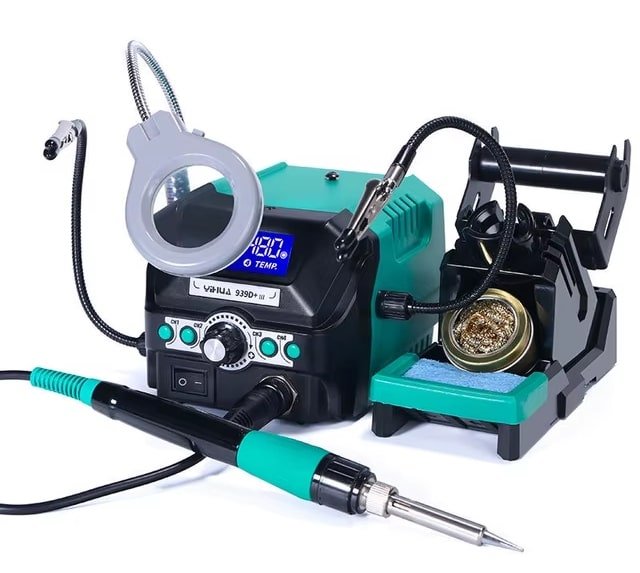
YIHUA 939D+ III EVO, Best Overall for Electronics
110W · 4-core element · PID · LED magnifier · 4 presets · £69.50
The iron most electronics hobbyists settle on. 110W with a 4-core element recovers fast on ground planes and connectors, PID keeps the tip exactly where you set it, four presets cover lead and lead-free, and the built-in magnifier helps on small SMD parts. It runs Hakko 900M-compatible tips, so genuine spares are cheap and everywhere. For everything from Arduino to PCB assembly, this is the all-rounder.
Best for: Arduino and PCB work, regular electronics projects, anyone who wants room to grow.
Key Features:
- • 110W 4-core element, PID control.
- • Integrated LED magnifier lamp.
- • 4 memory presets; auto-hibernation.
- • Hakko 900M-compatible tips.
- • UK stock, 12-month guarantee.
Best Applications:
- • Arduino and microcontroller projects.
- • PCB assembly and through-hole.
- • General electronics and repair.
- • A long-term all-round electronics iron.

YIHUA 937D+, Best Value for Electronics
75W · PID · Hakko 900M-compatible · LED indicator · £39
If you want a proper electronics iron without the extras, the 937D+ is the value pick: 75W of real PID control and Hakko 900M-compatible tips you can buy cheaply anywhere. It handles Arduino, through-hole and most general electronics with ease, and there is nothing to fiddle with. More at this price in the budget soldering station guide.
Best for: budget electronics, Arduino, through-hole and general projects.
Key Features:
- • 75W PID, real temperature control.
- • Hakko 900M-compatible tips.
- • LED ready indicator, anti-static.
- • Simple, reliable operation.
- • UK stock, 12-month guarantee.
Best Applications:
- • Arduino and through-hole electronics.
- • General repairs and DIY.
- • A first proper electronics iron.
- • Upgrading from an analogue iron.
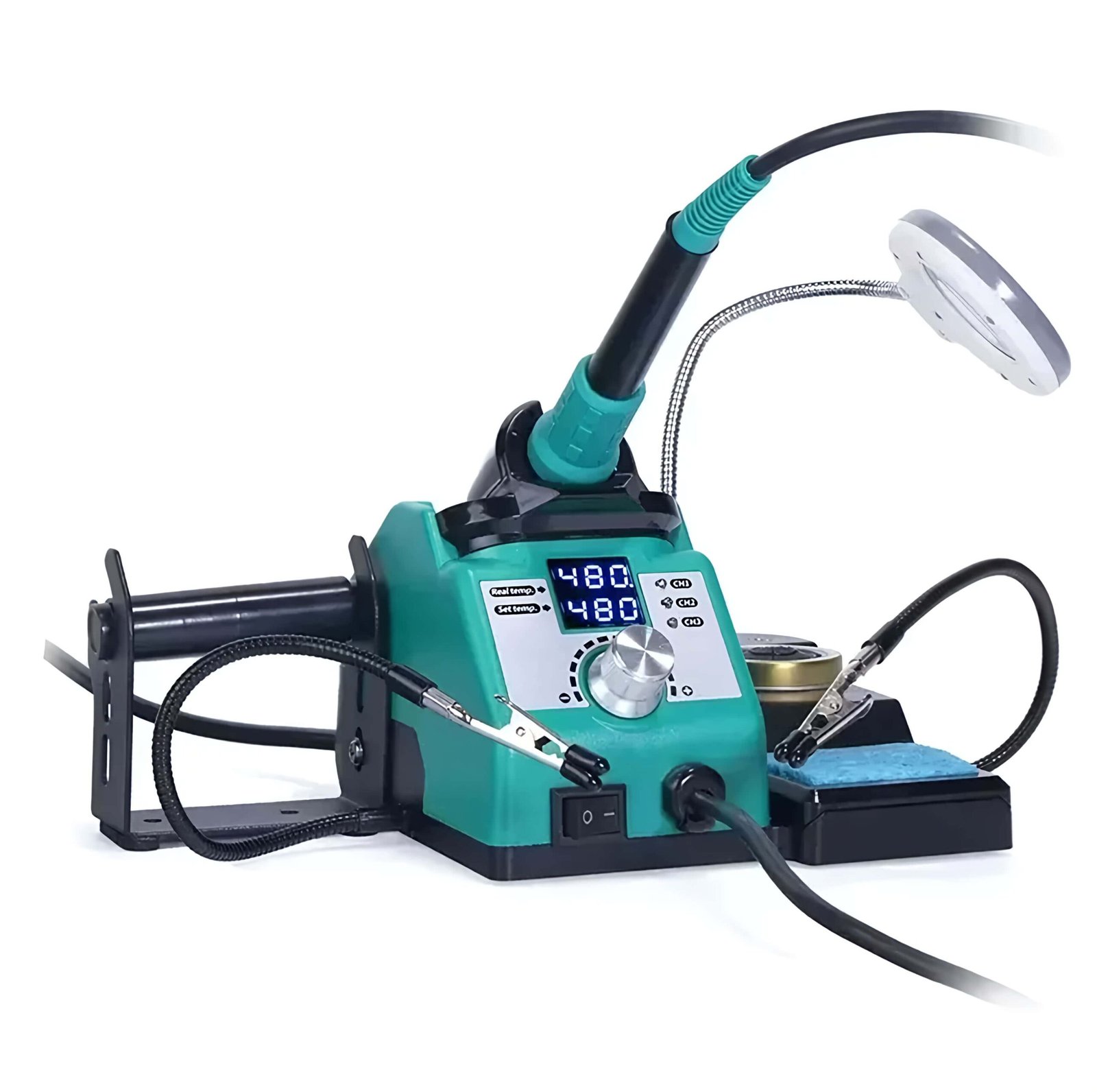
YIHUA 926LED-IV, Best Complete Kit Under £40
60W · PID · 3 pre-set channels · Helping hands · £32.50
The cheapest complete electronics setup in the UK. Three pre-set temperature channels mean you set it and solder, the helping hands hold your board, and 60W PID control keeps joints clean. A brilliant first electronics iron for students and beginners. New to it? See the beginners guide.
Best for: first electronics iron, students, Arduino and hobby projects.
Key Features:
- • 60W PID, 3 pre-set channels.
- • Helping hands and stand included.
- • 90-480°C range, sleep mode.
- • Complete, ready to solder.
- • UK stock, 12-month guarantee.
Best Applications:
- • A first electronics iron.
- • Arduino and school projects.
- • Through-hole and hobby builds.
- • A complete setup for under £40.
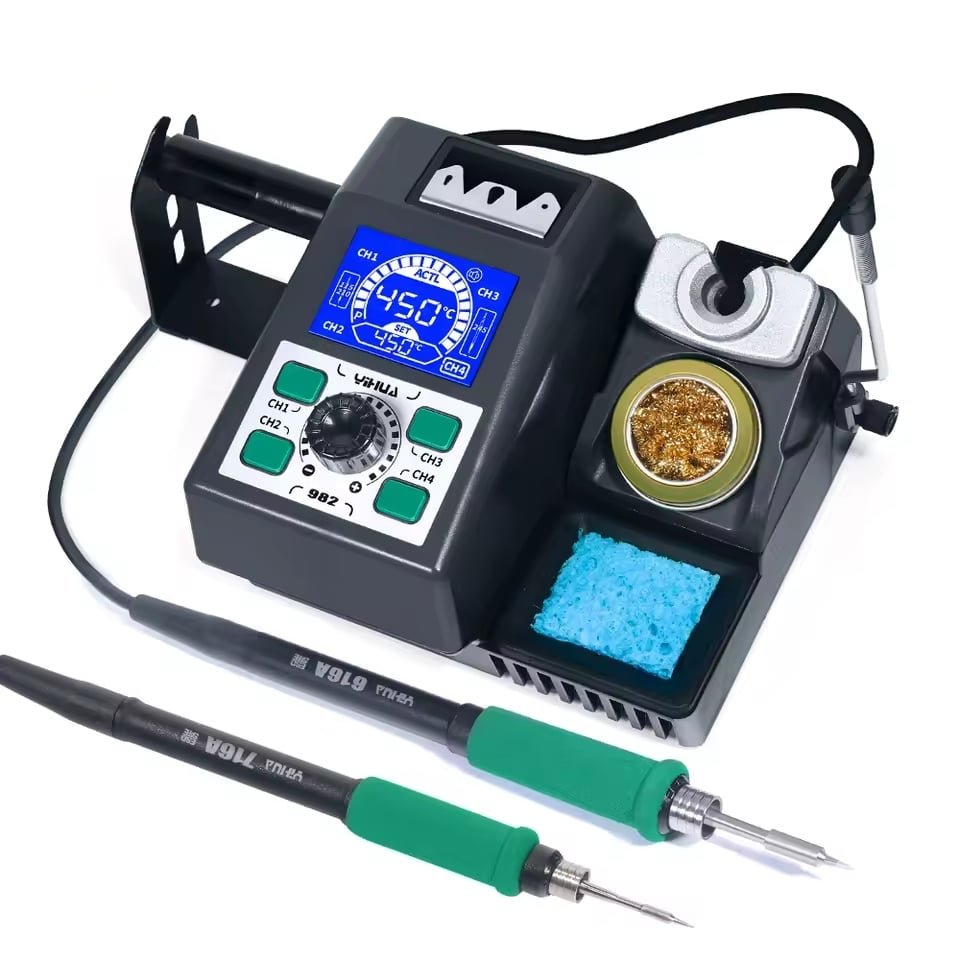
YIHUA 982, Best for Fine SMD Electronics
C210 + C245 cartridge · 2-7s heat-up · ESD-safe · £68
For fine-pitch electronics, cartridge tips change the game. The 982 puts the heater inside the tip for 2 to 7 second heat-up and instant recovery: C210 for 0402 parts and fine SMD, C245 for heavier joints. ESD-safe and precise, it is the pick for board repair and microscope work. Compare tips in C210 vs C245 vs 900M tips.
Best for: SMD, microscope work and precision board repair.
Key Features:
- • Dual C210 + C245 cartridge handles.
- • 2-7 second heat-up, instant recovery.
- • Full-colour LCD, PID control.
- • ESD-safe throughout.
- • UK stock, 12-month guarantee.
Best Applications:
- • Fine SMD and 0402 components.
- • Board and trace repair.
- • Microscope precision work.
- • A fast precision iron for electronics.
YIHUA 928D-IV, Best Portable for Field Electronics
USB-C powered · 5s heat-up · Cordless · £44.50
When the work is not at your bench, the 928D-IV runs off any USB-C source, a laptop charger, power bank or wall adapter, and reaches working temperature in about five seconds. Controlled, precise and pocketable, it is ideal for field repairs, drone and RC fixes, and quick jobs where dragging out a station makes no sense. See the full cordless soldering iron range.
Best for: field and on-site repairs, drone/RC fixes, a portable second iron.
Key Features:
- • USB-C powered, runs off a power bank.
- • 5-second heat-up, controlled temperature.
- • Compact and cordless.
- • ESD-safe design.
- • UK stock, 12-month guarantee.
Best Applications:
- • Field and on-site electronics repair.
- • Drone, RC and hobby fixes.
- • Quick jobs away from the bench.
- • A portable backup to a station.
Wattage, Tips & Temperature for Electronics
What wattage for electronics?
60 to 75W of PID-controlled heat is the sweet spot for electronics. It is enough to recover on pads and small joints without the bulk of a 100W+ iron. Step up to 110W (the 939D+ III EVO) only if you regularly hit ground planes or thick wire. Power without temperature control is the wrong trade, a 60W PID iron beats a 100W analogue one for electronics every time.
Which tip?
A small chisel tip (2-3mm) handles around 90% of electronics work; add a fine conical or bevel for SMD. Hakko 900M-compatible tips (937D+, 939D+ III EVO) are cheap and everywhere; cartridge C210/C245 tips (982) heat and recover fastest for fine-pitch work. Browse soldering iron tips.
What temperature?
Leaded solder 330-350°C, lead-free 380-400°C, heat-sensitive parts 280-300°C. Start lower and increase. Full breakdown in the soldering iron temperature guide.
Frequently Asked Questions
What soldering iron is best for electronics?
A temperature-controlled PID station, not a bare iron. For most people the YIHUA 939D+ III EVO (£69.50) is the best all-round electronics iron; the YIHUA 937D+ (£39) is the value pick, and the cartridge YIHUA 982 (£68) is best for fine SMD.
What wattage soldering iron do I need for electronics?
60 to 75W with PID control covers most electronics. More watts without temperature control does not help; a 60W PID iron outperforms a 100W analogue one. Choose 110W only for ground planes and heavy joints.
Do I need a soldering station for electronics, or just an iron?
A station. Electronics components are heat-sensitive and joints are small, so you need exact temperature control and fast heat recovery, which a fixed-temperature iron cannot give you. A PID station is the right tool.
What temperature should I solder electronics at?
Around 330-350°C for leaded solder and 380-400°C for lead-free, and 280-300°C for very heat-sensitive parts. Always start lower and increase if the solder is not flowing.
Is a cordless soldering iron any good for electronics?
Yes, for portable and field work. A USB-C iron like the YIHUA 928D-IV gives controlled temperature off a power bank, ideal for repairs away from the bench. For your main bench, a mains station is still better for sustained work.
The best all-round electronics iron is the YIHUA 939D+ III EVO at £69.50, or browse the full range.
View All Soldering Stations →