

A soldering iron tip that will not take solder is usually dirty, not dead. Cleaning it the wrong way, sandpaper, a file, aggressive abrasives, is what actually kills a tip early. This guide covers what to use, what to avoid, and how to tell the difference between a tip that needs cleaning and one that needs replacing.
Quick answer: wipe the hot tip on brass wool (or a damp sponge) before every joint, then immediately apply fresh solder to re-tin it before you set it down. Never sand, file, or use steel wool on a plated tip, it strips the protective plating and the tip corrodes fast after that. See replacement tips if cleaning does not bring it back.
UK stock · same-day dispatch before 2pm · free delivery over £35 · 12-month guarantee · 60-day returns
Why Tips Go Black and Stop Taking Solder
A soldering iron tip is plated copper working at 300°C or more, in contact with flux and air. That combination oxidises the surface, the black or grey crust you see building up is oxidised metal and burnt flux residue, and it stops fresh solder from wetting the tip properly. The longer a tip sits hot and idle without being wiped or re-tinned, the faster this builds up. It is a normal part of using a soldering iron, not a fault, cleaning is how you manage it.
Brass Wool vs Wet Sponge
Both work. They are not equivalent.
A wet sponge cools the tip every time it touches it, because you are putting a cold, damp surface against a 300°C+ metal tip. On a station without fast recovery, that temperature drop shows up in your next joint. It also has a very mild scouring action that wears the tip's plating slightly with each wipe.
Brass wool (also sold as a "dry" tip cleaner) does not carry the same cooling effect and is gentler on the plating, because it is cleaning by light abrasion from soft brass strands rather than thermal shock. Several of our stations, including the YIHUA 982 and the 939D+ III EVO, ship with a brass wool cleaner built into the base for this reason.
If you only have a sponge, use it, damp rather than dripping wet. If you have both, use brass wool as your default wipe and save the sponge for heavier residue.
How to Clean a Soldering Iron Tip, Step by Step
- Bring the iron to working temperature. A cold or lukewarm tip will not release oxidation, cleaning only works properly at soldering heat.
- Wipe on brass wool or a damp sponge in one motion. This lifts the burnt flux and oxidation layer off the surface.
- Re-tin immediately. Touch fresh solder to the cleaned tip so a thin, shiny layer covers it again before it has a chance to oxidise bare.
- Repeat between joints, not just when the tip looks obviously dirty. A wipe every few joints keeps oxidation from building up in the first place.
- Before storing the iron, wipe once more and leave a fresh coat of solder on the tip rather than leaving it bare overnight.
What Not to Do
- Sandpaper or a file. Modern tips have an iron plating over the copper core specifically to slow oxidation and resist wear. Sanding cuts straight through that plating, and once it is through, the exposed copper corrodes far faster than before.
- Steel wool. Same problem as sandpaper, it is abrasive enough to strip plating rather than just lift surface residue. Brass wool is the safe equivalent, it is soft enough not to cut through plating.
- Leaving the tip bare after cleaning. A cleaned but un-tinned tip oxidises within minutes at soldering temperature. Always follow a wipe with fresh solder.
- Switching the iron off and on repeatedly instead of using standby. Thermal cycling, heating from cold each time, is what wears a tip out mechanically over its life. If your station has a standby or sleep mode, park the iron in the holder between jobs and let it use that rather than powering off.
When to Stop Cleaning and Replace the Tip
Cleaning restores a dirty tip. It does not restore a worn one. Replace the tip rather than continuing to clean it if you see any of the following: solder will not wet the tip even straight after cleaning and re-tinning, there are visible pits or craters in the plating, or the tip has visibly eroded from its original shape. At that point the plating itself has failed and no amount of cleaning brings it back.
Match the replacement to your iron's mounting standard. Conventional 900M-family YIHUA stations take 900M-T tips (£1.45), the YIHUA 902-series irons take 902-series tips (£1.55), and cartridge stations like the YIHUA 982 take C210 or C245 cartridges (£5.90 each). See our tip types guide if you are not sure which your iron uses.
Replacement Tips

900M-T Series Soldering Iron Tips
Fits YIHUA 939D+, 878D, 995D, 853D, 862BD+, 899D+, 8786D
The standard replacement for most YIHUA hobby stations, worth keeping a spare on the bench once your current tip starts showing pitting.
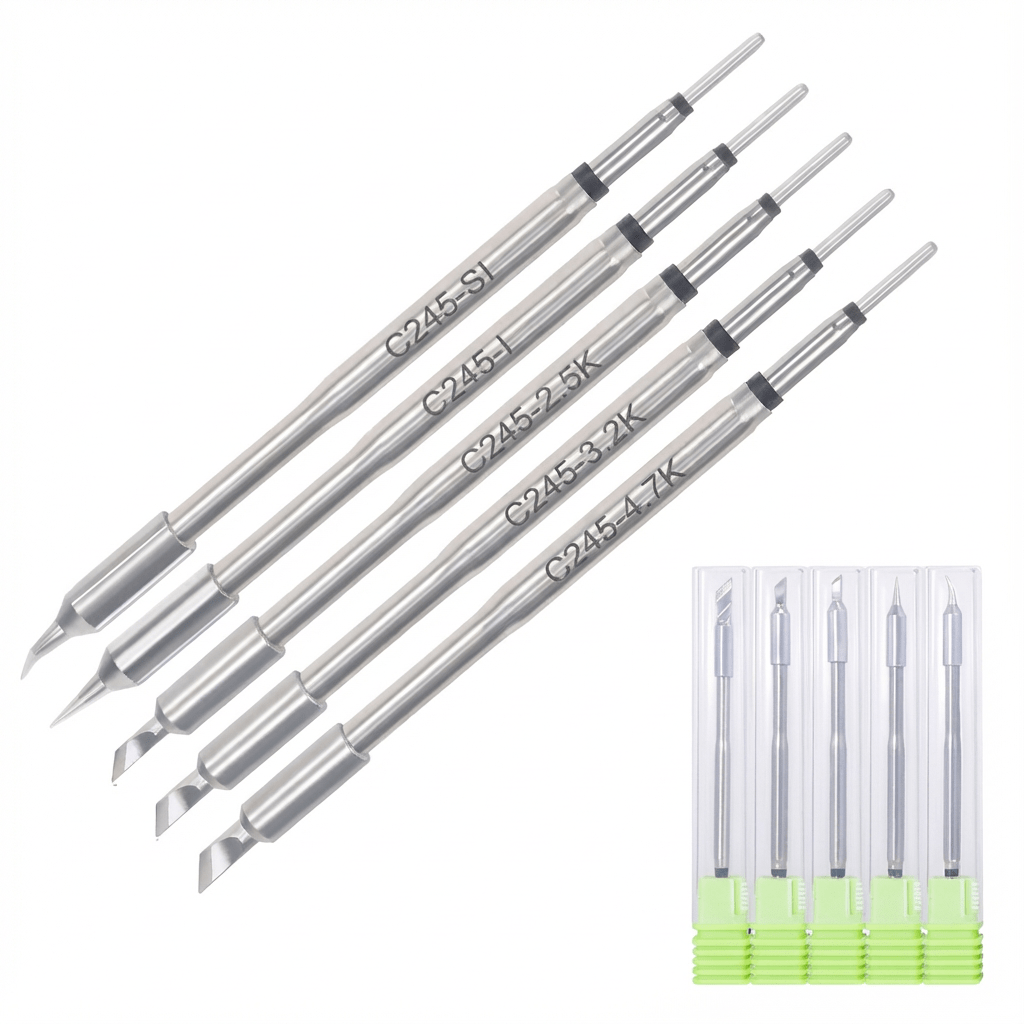
C245 Cartridges Precision Soldering Tips
Fits YIHUA 982 and 982-V
Cartridge replacement tip for JBC-compatible YIHUA stations. Once the plating pits, replace rather than keep cleaning.
Frequently Asked Questions
What can I use to clean my soldering iron tip?
Brass wool (a dry tip cleaner) or a damp sponge, used while the tip is hot, followed immediately by fresh solder to re-tin it. Brass wool is gentler on the tip's plating and does not cool it the way a wet sponge does.
How can I remove oxidation from my soldering iron tip?
Heat the iron to working temperature, wipe on brass wool or a damp sponge, then re-tin with fresh solder straight away. For a tip that will not clean up with normal wiping, that is usually a sign the plating has worn through and the tip needs replacing rather than more aggressive cleaning.
Can I use steel wool to clean a soldering iron tip?
Not recommended on a plated tip. Steel wool is abrasive enough to cut through the iron plating that protects the copper core, and once that plating is gone the tip corrodes much faster. Brass wool is the safe alternative, soft enough to lift residue without cutting the plating.
Do soldering iron tips go bad?
Yes, plating wears out over time even with correct cleaning. Signs it needs replacing rather than cleaning: solder will not wet the tip after a clean and re-tin, visible pitting or craters, or a shape that has visibly eroded.
Browse the full tip range to find the exact fit for your station.